A gun drilling pilot hole places the initial guide in the workpiece. A guide bushing supplies it through the external setup. They are alternative arrangements for the entry task, with different features to prepare and inspect.
Entry guidance and guidance inside the bore
Gühring’s single-lip FAQ describes a tool without self-centering at entry, guided by a bushing or a prepared pilot. It separately describes circumferential guide lands that guide the tool in the bore. These are distinct parts of the explanation: the entry arrangement must exist before relying on the bore that will be produced.
Do not treat the label “gun drill” as an entry instruction. Keep the selected drill series and the maker’s applicable operating instructions on the setup sheet, including the approved motion and coolant sequence.
When the workpiece contains the pilot
The pilot is a prepared feature with an intended axis and a relationship to the eventual bore. Its drawing or setup instruction needs dimensions appropriate to the selected drill, alongside the relevant position and preparation method. Retain the actual preparation and inspection record.
Consider an illustrative two-fixture route: a pilot is produced in fixture A, then the part is transferred to fixture B for deep drilling. Even if both setup sheets say “on centre,” the records still need to explain how fixture B locates the prepared feature and relates it to the intended bore. A transferred part is a reason to examine the reference chain, not proof that the pilot is wrong.
The next useful record is the pilot as it was made, rather than its nominal CAD location alone. If the later bore changes, distinguish a preparation change from a tool or deep-drilling setup change.
When an external bushing supplies the entry
Identify the installed bushing, its condition and its relationship to the held workpiece. The relevant comparison is between the actual guided entry and the intended bore axis. A correct tool identity does not document a bushing’s installation or wear.
If a bushing is replaced during an investigation, preserve the old identity, the new identity and the setup relationship that was checked. A better exit result after replacement supports a useful comparison; it does not isolate wear from a simultaneous alignment adjustment.
| Entry arrangement | Feature that supplies initial guidance | Record most likely to be lost in an incomplete setup sheet |
|---|---|---|
| Prepared pilot | Workpiece feature | Preparation/inspection and reference transfer |
| External bushing | Installed guide | Guide identity, condition and alignment to the held part |
Dimensions need the selected tool’s instructions
This source establishes the arrangements, not one pilot depth or clearance for every drill. Specify the actual pilot or bushing fit from the applicable tool/machine documentation. Resolve an undocumented dimension before turning an unrelated catalogue value into a shop instruction.
When the question is repeated exit offset, continue to alignment investigation. When the entry is established but returning chips change, follow the chip-evacuation path instead of treating every problem as an entry defect.
Keep guidance dimensions attached to their tool construction
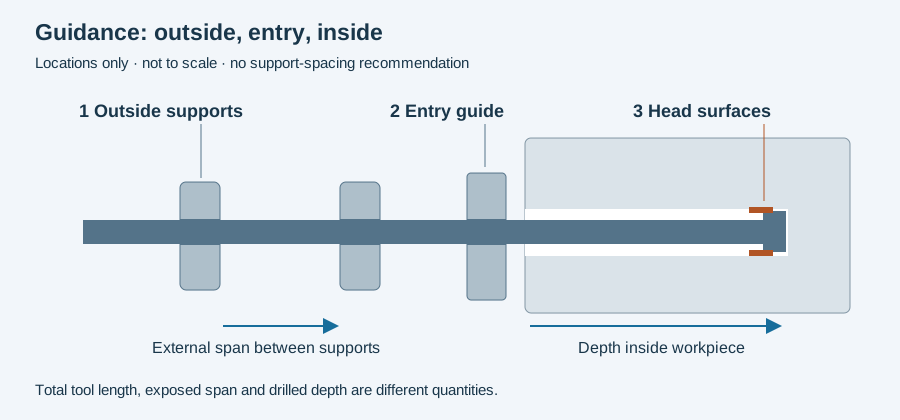
The botek catalogue gives guidance information within named tool and diameter ranges. Copying a pilot dimension from one table without its tool type loses part of the instruction. The entry guide, the support outside the workpiece and the head’s guide surfaces also act at different locations, shown below.
Brecht’s technical page describes its own entry procedure. That is supplier guidance, not evidence that the same movement is suitable for every gun-drilling installation. Where instructions differ, identify the applicable tool and machine procedure before programming the cycle; this article does not combine their steps into a new sequence.
For a two-fixture route, retain both the pilot reference and the second operation’s locating reference. A correctly sized pilot can still be displaced relative to the later tool axis. That distinction leads directly to the alignment article and the bore-quality worksheet.
Revision note
October 8, 2026: revised the technical explanation and connected reading after source review. Original publication date and URL retained.