Follow the fluid and the chips
Gun drilling sends cutting fluid through passages inside the tool. The return stream carries chips along the outside groove. UNISIG describes this arrangement in its English process explanation and German Einlippenbohren overview. That distinction separates gun drilling from the internal chip return used in BTA drilling.
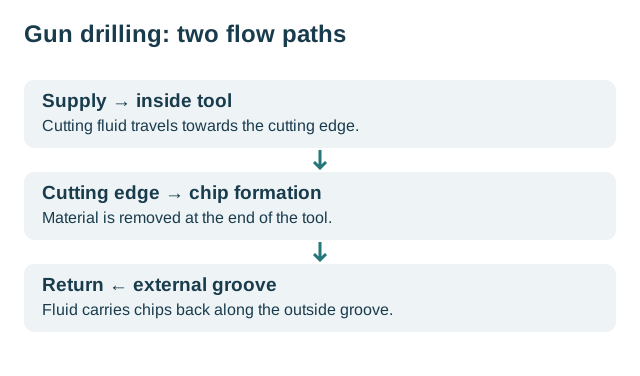
Editorial mechanism sketch, not a tool drawing or a coolant specification. Based on the two process descriptions above.
The sketch explains a route, not a pressure setting. A pressure reading without its measurement location, fluid condition and selected tool leaves the actual supply at the edge unresolved. Begin with the tool maker’s application documentation before choosing a trial setting.
Read the construction before choosing a setup
Two catalogue entries can share the name “gun drill” while differing in cutting-section construction and service requirements. Read gun drill geometry and types alongside the manufacturing-process explanation. Identify the exact assembly under discussion; a service procedure for one construction is not a procedure for every gun drill.
| Question at this stage | Reading route | Record for your job |
|---|
| What carries the fluid and returns the chips? | Coolant systems | Tool passages, supply measurement and return route |
| How is the selected assembly guided? | Setup and alignment | Entry guidance, support arrangement and drawing reference |
| Which setting is actually documented? | Speeds and feeds | Material condition, tool identity and approved trial scope |
Finish with the bore requirement
A completed drilling cycle and an accepted bore answer different questions. Before a trial, connect the drawing to an inspection plan: which characteristic, at which location, using which method? Keep the resulting report with the setup record. This is our editorial route through the topic; it does not supply a universal machining recipe.
If the immediate problem is a changing chip stream or a damaged tool, move to the incident record and document what changed before selecting a cause. The articles below cover the individual parts of that investigation.
Article archive · page 2
Browse this topic by question →
Interpret a surgical-instrument gun-drilling application through the blank, bore sequence, clamping, transfer and inspection rather than the industry name.
Understand how the spindle, entry guidance, whip supports, chipbox and fluid system work together when assessing a gun-drilling machine.
Compare gun drilling materials using grade, supplied condition and tool-specific catalogue classifications; separate listed guide values from measured …
Evaluate a gun-drilling precision claim by its specified characteristic, inspected locations, reference system and measurement evidence.
Convert gun drilling cutting speed to rpm and feed per revolution to feed speed; read a tool-specific catalogue example without treating it as a universal …
Start gun drilling troubleshooting from the observed defect, separate competing explanations and use a controlled comparison with an inspected outcome.
Follow the gun-drilling mechanism from entry guidance to in-bore cutting and external chip return, with operating-sequence limits kept separate.
Understand gun drilling through its fluid circuit, single-lip cutting tool and guidance, then distinguish the process from its achieved bore quality.