A broken gun drill is a physical outcome. It does not, by itself, identify chip blockage, entry misalignment or a particular cutting setting as the cause. The investigation starts with the evidence that remains available after the event.
Observation time is not necessarily damage time
Identify when the breakage was first detected and what the cycle record shows before that point. A fragment discovered during withdrawal establishes when it was found; it does not automatically establish when the crack or final separation occurred.
Retain the tool identity, service state and accessible fracture or wear observations. Separate a directly observed chip accumulation from an inferred blockage. If coolant or machine readings were not recorded during the relevant interval, a normal reading obtained afterwards does not reconstruct that interval.
Follow the relevant route through the installation
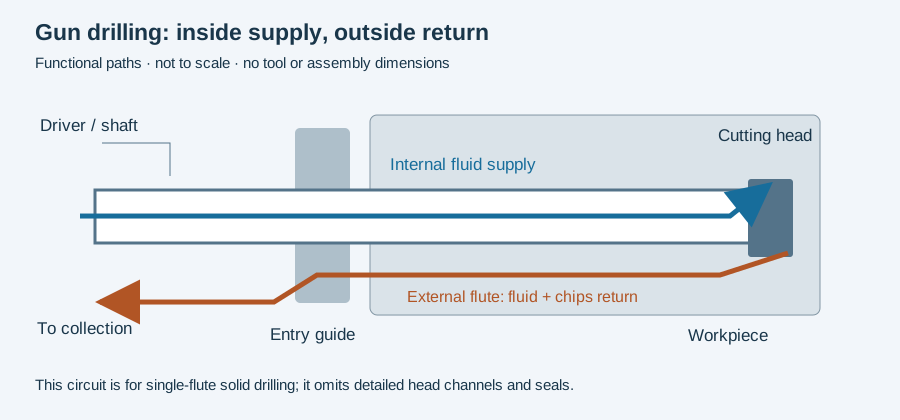
The conventional single-lip architecture shown below supplies fluid through the tool and returns fluid and chips outside it. The botek catalogue describes this arrangement and its entry-guidance context. A suspected return-path problem therefore needs evidence from that route, not only the pump’s nominal specification.
The catalogue also contains tool-specific operating guidance. It is not a single recovery procedure for all constructions and machines. Apply the applicable controlled tool and machine instructions when handling a damaged installation; no restart sequence is invented here.
Build comparisons from supported hypotheses
Star Cutter discusses several possible contributors to tool wear and poor bore results. Use that discussion to identify what evidence would distinguish competing explanations. Do not convert the list into a confirmed diagnosis of the broken tool.
For an assumed comparison, a replacement tool runs without breaking after both the entry fixture and fluid configuration were changed. That observation supports the new combined condition. It does not identify which change mattered or demonstrate the original cause. Retain any recurrence interval and inspected output with the result.
Connect prevention to an observable endpoint
An investigation can lead to a controlled operating or inspection change before every contributor is resolved. Describe the change accurately and retain the unresolved question. A recurrence-free interval and acceptable bores are meaningful observations within their recorded scope; neither establishes unlimited tool life.
Use the incident worksheet to preserve the event and comparison. Continue to troubleshooting for selecting an evidence route and to quality control for identifying the bore inspection required after recovery.
Revision note
October 8, 2026: revised the technical explanation and connected reading after source review. Original publication date and URL retained.