What was announced
On April 1, 2026, IFW at Leibniz University Hannover reported completion of AutoBohr with iba AG. The project addressed monitoring drilling in single-part production. This is coverage of that dated institute report. Original English announcement.
What the institute describes
IFW describes identifying drilling phases and evaluating each phase separately, using historical data and neural networks. These are attributed project descriptions. The corresponding German announcement was also inspected before writing.
Limits of this brief
We have not independently tested AutoBohr or verified a universal detection accuracy. The announcement is not evidence that every gun-drilling or BTA installation is covered. A project completion should not be read as confirmation of a commercial release.
For application questions, read the AutoBohr research analysis and in-process monitoring guide.
Source check
The English and German public announcements were checked on October 7, 2026. This brief distinguishes the source date from our publication date. Editorial policy and corrections.
Three decisions behind one alarm
IFW describes a phase-recognition module before the assessment of drilling signals: air cutting, engagement and exit are treated as different stages. Historical-data assessment and a neural-network approach for unfamiliar conditions are further parts of the reported system. This architecture matters because a signal transition at a planned phase boundary is different evidence from an unexpected transition within engagement.
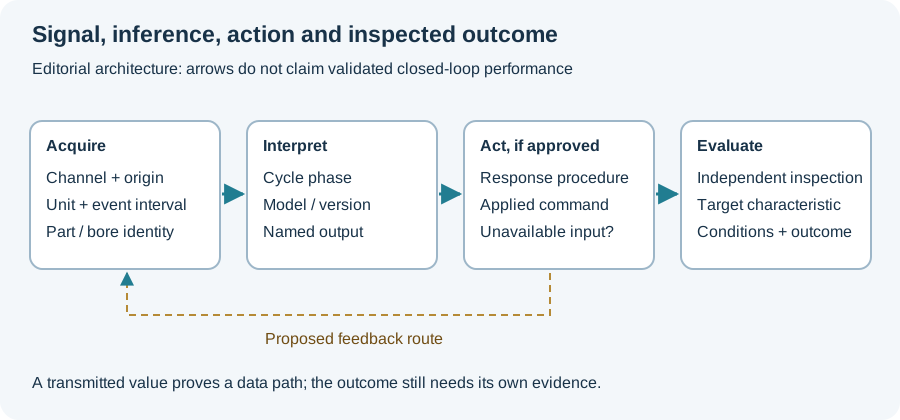
Detection, response and acceptance should be kept visible as three decisions. The first classifies the observed signal; the second determines what the machine or operator does; the third evaluates the resulting component. IFW reports testing at a contract manufacturer, but its announcement does not publish a confusion matrix, an application-specific false-alarm rate or a complete finished-bore dataset.
Our application interpretation is to associate an alarm with the program stage, tool identity and subsequent inspection. A short event record can preserve the interrupted depth and the action taken, making a recurring alarm easier to compare without assuming that all alarms represent the same physical fault.
The feedback-stage diagram below places final inspection after the monitoring response. Use the incident tool to record an actual event; the next readings separate first-part monitoring from claims about final bore quality.
Revision note
October 8, 2026: revised the technical explanation and connected reading after source review. Original publication date and URL retained.