The announcement
DMG MORI’s January 26, 2026 release introduced Adaptive Drilling Control (ADC) for machining-center drilling. The company linked the announcement to its Pfronten exhibition. This brief covers that dated release, not a new October launch. English announcement.
What the manufacturer describes
The release describes standard drilling, deep-hole drilling and ADC Advanced modes. It says pressure, flow and load information supports adaptive process control. These are manufacturer descriptions; this brief does not independently validate their performance. The German announcement was also inspected on October 7, 2026.
Editorial follow-up
Before evaluating ADC for a part, request current machine compatibility, control/software requirements and application documentation. Use a defined production trial to assess benefits. The dated announcement alone does not confirm suitability for an individual installation.
For a fuller interpretation, read our product evaluation guide and documentation checklist.
Source check
The brief rests on DMG MORI’s own English and German releases. It carries no independent test result and no machine-specific operating manual. See our editorial policy for source boundaries and corrections.
Tie the controller’s action to a particular hole
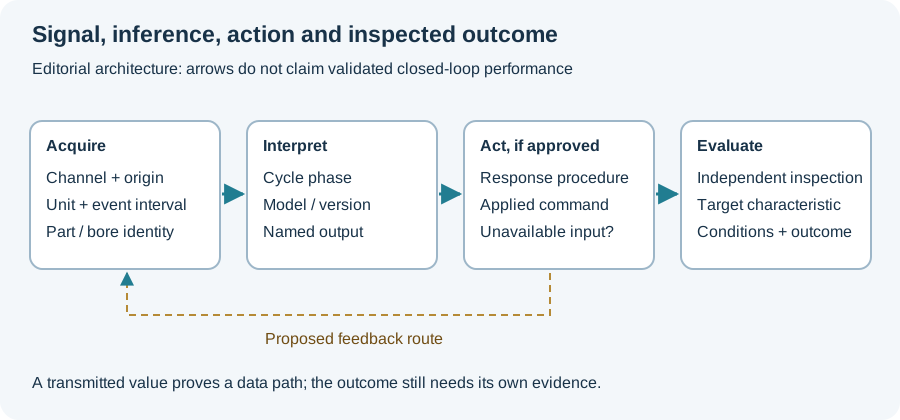
The manufacturer’s description links Adaptive Drilling Control to pressure, flow and machine-load information. That is a control proposition: the machine observes a process state and changes its response. It does not make a finished bore conforming merely because the controller remained active.
For an application assessment, preserve the technology-cycle version and machine configuration with the program. The meaningful comparison is an identified operation on an identified part, using a specified tool and an inspection method that covers the required characteristics. A family-level productivity claim cannot supply these missing details.
Our editorial reading is to ask for the chronology: the operating stage, signal observation, commanded response and subsequent bore result. If a demonstration reports shorter drilling time, identify whether setup, tool changes, interruption recovery and inspection were inside its timing boundary. This article asserts no independent saving for another installation.
The feedback-stage figure below makes the inspection step explicit. Use the RFQ worksheet to request the compatible machine/control configuration and a defined acceptance trial. Continue to the CNC evidence guide and in-process feedback discussion for the records needed around the announced function.
Revision note
October 8, 2026: revised the technical explanation and connected reading after source review. Original publication date and URL retained.