ECOROLL’s October 17, 2024 article by Oliver Maiß describes cylinder-tube machining through skiving and roller burnishing. It contains a useful limitation: the skiving arrangement follows the existing bore, so prior bore-path deviation is not sustainably corrected by that step. Manufacturer-authored original. This article is an archive reading, not a new product announcement or an independently measured customer case.
Separate the jobs within the tool
The article distinguishes the material-removal stages from the later rolling stage. Its English OMEGA product description provides additional context on combined tool configurations. A stage arrangement should remain attached to the named tool rather than becoming a universal claim about every finishing route.
The editorial implication is straightforward: an attractive finished surface should not be used to infer that an incoming axis problem has been corrected. The drawing’s geometry and surface requirements need their respective inspection evidence.
Read the starting condition in a proposal
Ask which operation establishes the incoming bore, what measurements describe it, and which subsequent stage is responsible for each final characteristic. When two offers assume different starting conditions, compare those route boundaries before comparing their quoted finishing time.
The source discusses productivity and process capabilities from the manufacturer’s perspective. It is not a matched independent comparison that establishes a saving for an unspecified cylinder, nor does it justify choosing one finishing method for every application.
Use the limitation in route planning
For an actual job, keep the pre-process record beside the finished-bore report. That pairing allows a review of what changed and which characteristic was evaluated. Continue to skiving stock allowance and bore preparation for the incoming condition, or finishing-method selection for the broader route decision.
Editorial policy and corrections.
Compare the same bore before and after finishing
ECOROLL’s explanation of a floating tool following the existing bore path gives the incoming tube geometry a continuing role. A smoother internal surface does not describe how the bore axis lies relative to the external locating features.
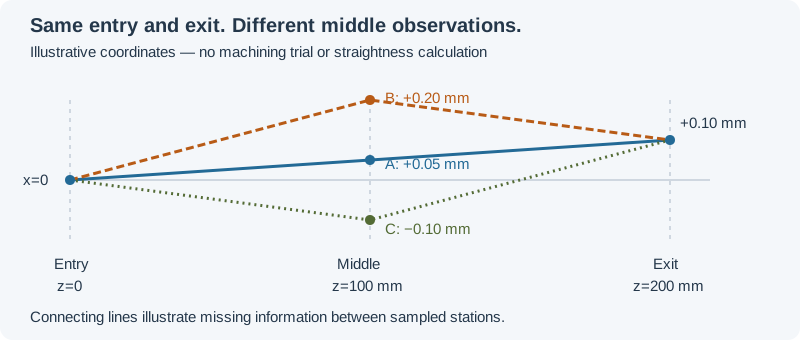
This distinction changes the comparison record. Keep the part’s identity and locating arrangement with the incoming and finished observations. Specify where diameter and surface texture were measured, then separately record the observations used to assess the internal path. Two accepted endpoint diameters do not describe every interior section.
The bore-path sketch below is an invented geometric example, not ECOROLL test data. Its purpose is to show why identical endpoints can leave different internal observations. It helps interpret the manufacturer’s explanation without turning the illustration into a claimed correction capability.
For an actual cylinder, use the bore-quality worksheet to attach each required characteristic to its inspection method. The next readings explain the difference between straightness evidence and a process comparison with honing. The source supports discussion of tool behavior and finishing stages; this site has no matched cylinder trial establishing a universal improvement in bore-axis geometry.
Revision note
October 8, 2026: revised the technical explanation and connected reading after source review. Original publication date and URL retained.