The manufacturer’s question
ECOROLL’s English article discusses bringing complete cylinder machining onto standard machine tools. Its German counterpart shows June 11, 2025, clarifying the English 06/11/2025 label. This is historical manufacturer application information.
Convert the proposition into an evaluation
Our editorial recommendation is to ask for a complete integration proposal rather than treating the machine category as evidence of readiness. Identify the actual machine, holder and tool connection, support through the stroke, incoming tube condition and end features. Obtain the approved tooling procedure and an inspection plan for the delivered bore.
Compare the proposed route with purchased finished tube or another finishing route on the same part and quantity. Include preparation, handling, tooling, inspection, rejected parts and finishing of the ends. Record costs actually quoted for the job; no generic saving is asserted here.
Evidence boundary
The inspected material is a tool manufacturer’s discussion. We have not performed a matched production trial, verified savings or confirmed suitability for an unspecified lathe. An advertised advantage remains a supplier claim until the relevant application evidence is available.
Use SRB versus honing and the RFQ worksheet to frame the comparison.
The return stroke and chip exit are integration questions
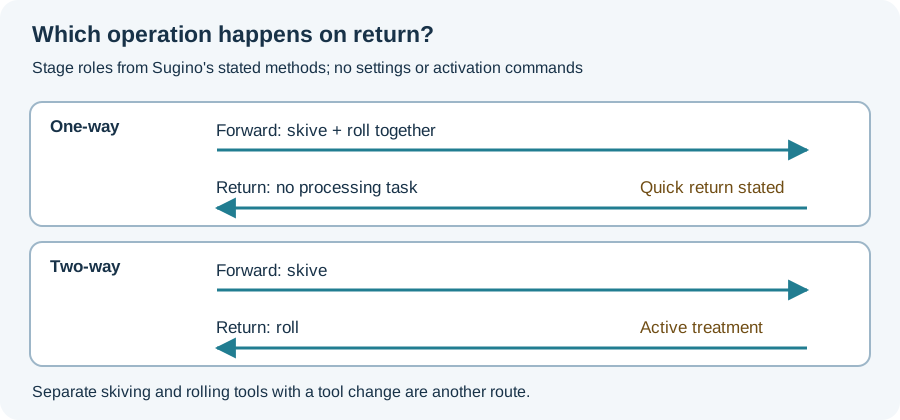
The German article describes fluid-actuated skiving knives that retract for the return stroke and chips discharged ahead of the tool. These features make the full stroke and the space beyond the tube relevant to an installation proposal. The category ‘standard machine tool’ alone does not establish that this path is available on an unspecified machine.
Ask the supplier to show the workholding, fluid connection, usable stroke and chip-exit arrangement on the proposed installation. The proposal should also distinguish the cut surface from any subsequent rolled finish. A claimed result from one stage should not silently become the acceptance specification for the completed route.
The source uses IT8 in discussing achievable accuracy. An ISO tolerance grade describes a dimensional tolerance interval; it is not a numerical roundness result. This article therefore does not turn that label into a verified form tolerance.
The cycle comparison below separates cutting from return and handling. Use the RFQ worksheet to make those stages explicit in the quoted scope, then continue to the SRB cycle and process-selection guides. All claimed machine suitability still requires review against the actual tube, installation and delivered-bore requirements.
Revision note
October 8, 2026: revised the technical explanation and connected reading after source review. Original publication date and URL retained.