The BIPM guide collection lists JCGM 100:2008/Amd.1:2026, addressing nonlinearity in measurement models. The substantive final page of the official amendment changes material associated with clause 4.1.4, example H.1.7 and the bibliography. This is a general metrology update, rather than a deep-hole drilling standard.
What the amendment addresses
The added guidance concerns a model whose nonlinearity is significant. It points to Monte Carlo treatment or the inclusion of higher-order terms, and revisits the example’s treatment of those terms. The published document should be read alongside the base GUM and relevant supplements; this article does not reproduce its equations or supply an implementation.
Why a bore report may need a model explanation
Our editorial application is a question for the inspection plan: how does the reported quantity follow from the observations, corrections and analysis? Before deciding that the update changes an inspection process, the responsible metrologist needs to identify the actual model and determine whether the condition addressed by the amendment is relevant.
Neither a long probe nor a tight drawing tolerance, by itself, establishes significant model nonlinearity. The update also supplies no universal uncertainty value for bore straightness, diameter or location.
Keep the reference revision visible
Name the documents and versions used in the evaluation. When a laboratory revises a procedure, retain the basis for the change and identify which reports or applications it covers. Do not describe a citation to the 2008 base text as proof that all later guidance has been considered.
For the introductory distinction between resolution and application uncertainty, read deep-hole measurement uncertainty. For coverage and geometric interpretation, use bore-axis evidence.
Editorial policy and corrections.
The estimate and its uncertainty need separate attention
The amendment discusses higher-order treatment of a significantly nonlinear model. Its example distinguishes effects on the estimate from contributions to uncertainty. Our reading is that checking only a displayed uncertainty value can miss the earlier question of how the reported quantity was calculated.
For a bore report, begin with the named characteristic and the observations used to derive it. Record the corrections, coordinate transformation or other analysis actually employed. This is a way to expose the model for review, not a statement that every bore measurement needs nonlinear treatment.
Keep procedure revision and report revision distinguishable. A revised calculation may apply to a defined set of measurements; a new reference in the bibliography does not identify that set. The responsible measurement specialist should establish the model’s applicability before changing the evaluation.
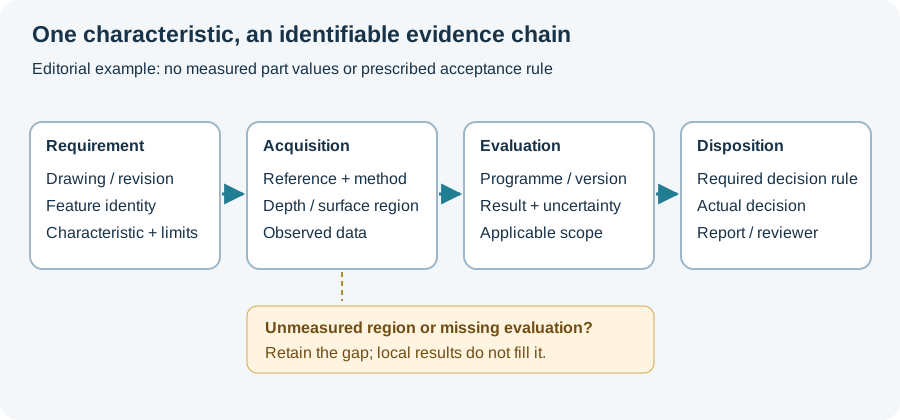
The diagram below connects observations, calculation and report. Use the quality worksheet to name the required characteristic and reporting method; it is not an uncertainty calculator. The two next readings explain the related issues of application uncertainty and statistical capability. Neither supplies a universal replacement for the actual measurement model.
Revision note
October 8, 2026: revised the technical explanation and connected reading after source review. Original publication date and URL retained.