Long-bore inspection begins with two questions: can the instrument reach the required feature, and can its observations be evaluated against the drawing? Eley Metrology and Novacam publish different arrangements for addressing these questions. This comparison reads their product descriptions; it does not rank their accuracy.
What the two pages describe
Eley’s Long Bore Measurement CMM page describes specialist long-reach probing and relating internal and external features to a common reference. Novacam’s BOREINSPECT page describes a rotating side-looking optical probe advanced along the bore, with point-cloud processing for application-specific results.
| Evaluation topic | Long-reach probing description | Optical scanning description |
|---|---|---|
| Access | Lance and probe arrangement | Probe, standoff and scanner arrangement |
| Reference and analysis | Common datum for related features | Scan data and selected analysis software |
| Application review | Reach and required feature relationships | Scan coverage and required outputs |
The table compares the published architectures. It is not a list of achieved results under matched conditions.
Compare the inspection task before the specifications
State bore diameter, accessible length, interruptions and the measured characteristic. Ask each provider for a proposed setup and report covering those conditions. Then examine how the result is evaluated and what uncertainty is associated with it.
A quoted resolution should remain a resolution specification; it is not a substitute for the application uncertainty statement. Likewise, the ability to produce a point cloud does not by itself establish that the agreed geometric requirement has been evaluated.
What would make a comparative trial useful
Use the same part definition, delivery condition and required report, and retain the actual setup for each arrangement. Review coverage and unavailable regions before comparing headline values. These are editorial trial-planning suggestions, not a report of tests performed by this site.
Read bore-axis evidence and measurement uncertainty for interpreting the resulting reports. Neither product page carries an exact publication date.
Editorial policy and corrections.
Compare one required characteristic at a time
Eley’s long-bore CMM description emphasizes contact-based geometric measurement. Novacam describes optical acquisition and analysis of bore-surface data. These descriptions identify different architectures and output possibilities. A common headline about depth or speed cannot establish that both inspected the same characteristic with the same coverage.
Start the comparison with the drawing question: diameter at specified sections, the internal axis relative to external features, or local surface features. Then describe the accessible region and the observation delivered by each proposed configuration. An image or point cloud needs an analysis definition before it becomes a form result.
Our editorial proposal is to use the same identified artifact and reference arrangement when requesting a demonstration. Retain the data, analysis settings and report, rather than comparing screenshots whose coordinate systems and coverage are unspecified. No head-to-head trial or accuracy ranking has been established for this article.
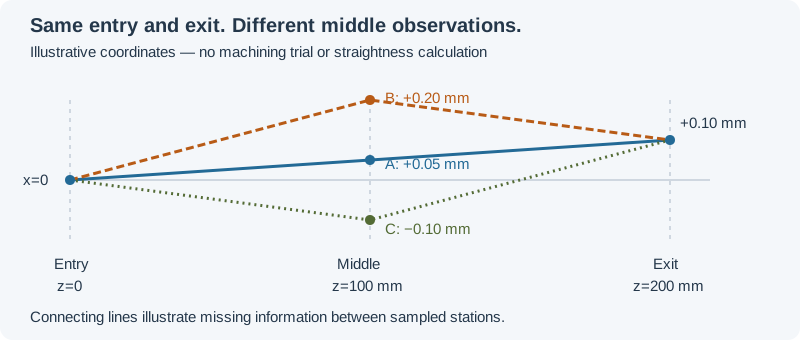
The path-coverage sketch below illustrates a sampling issue using assumed geometry. The bore-quality tool makes the required observations explicit. Continue to the measurement-method guide for the wider choice of instruments and the uncertainty guide for the distinction between instrument specifications and an application result.
Revision note
October 8, 2026: revised the technical explanation and connected reading after source review. Original publication date and URL retained.