A temporary inspection task
Novacam’s August 15, 2018 report describes an automated bore-chatter inspection assembled by Arnold Gauge for an unnamed automotive customer. The account names a BoreInspect system, a UR5 robot and analysis software applying the customer’s criteria.
Novacam reports inspection of more than 16,000 turbo shafts. It gives a 45-second inspection cycle, including a 5.5-second acquisition interval for two rotations, and says that 65% passed measurement tests and were salvaged. These are vendor-reported results for that task. We have not independently checked the parts or inspection records.
Three numbers, three different meanings
| Reported quantity | What the source associates with it | What it does not describe |
|---|---|---|
| 45 seconds | Inspection cycle | The machining cycle for a shaft |
| 5.5 seconds | Two-rotation acquisition within that cycle | The complete automated inspection interval |
| 65% | Reported inspection pass and salvage outcome | A general machining yield improvement |
The table is our interpretation of the source’s stated scope. Do not subtract the acquisition interval from an unrelated process or transfer the salvage percentage to new production.
Ask for the acceptance record
The source explains that this was a temporary inspection response while the line’s chatter problem was investigated. It does not publish the customer’s full acceptance criteria, a complete uncertainty evaluation or independent validation of the sorting result. Those omissions leave the transfer to another component unresolved.
For your application, specify the defect to be evaluated, the accessible bore regions, the method and the agreed decision rule in the quality worksheet. Read the bore-quality guide for the distinction between a measured characteristic and coverage of the whole requirement.
If the aim is to fix the process rather than sort existing stock, retain the chatter observations and subsequent changes in an incident record. Inspection outcome and investigation closure should remain separate records.
Sorting yield is not new-production yield
Novacam’s case concerns a stock of potentially defective turbo shafts. Its reported salvage proportion describes the disposition of that screened population. It cannot be used as the yield of a new drilling process or as proof that the source of chatter was eliminated.
The account also distinguishes acquisition from the complete inspection cycle. A measurement sequence includes actions around the scan, so an acquisition time and a total cycle time answer different planning questions. Retain both definitions when comparing throughput; this article does not derive an unreported production rate from the shorter number.
Connect a surface observation to the disposition
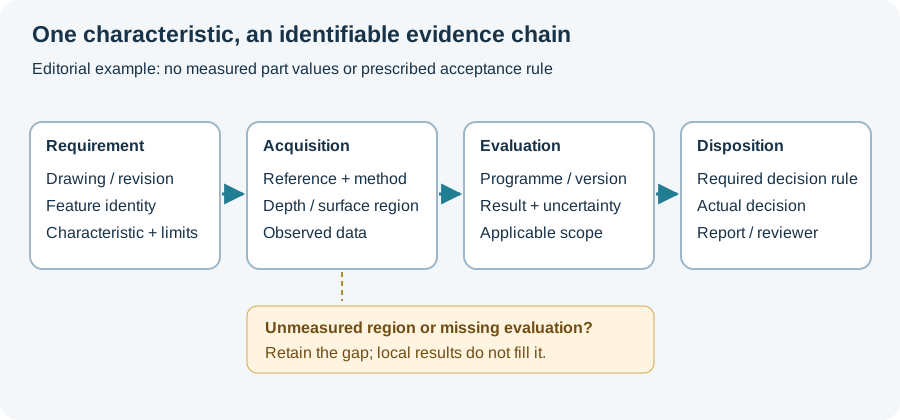
Our interpretation is to keep the shaft identity, observed surface feature and disposition together. A selected image of chatter cannot describe the whole lot, while a lot-level salvage percentage cannot identify what was observed on an individual shaft. The acceptance basis and inspected region therefore belong beside the reported screening result.
The measurement-to-report diagram below explains this link. Use the incident record to associate a recurring surface observation with its machining history. The next readings discuss measurement coverage and chatter investigation, keeping the historical supplier case distinct from a verified root-cause correction.
Revision note
October 8, 2026: revised the technical explanation and connected reading after source review. Original publication date and URL retained.