Start with the experimental apparatus
Nomura and colleagues’ 2022 experiment used a 0.28 mm ATOM ADRL drill on a vertical NC milling machine, TECAPEEK workpieces and manually applied external cooling spray. Table 1 lists drilled depths of 2.5–5.0 mm. The methods report four repetitions under each condition. Original nine-page paper, methods on page 544. The journal record dates publication to September 5, 2022.
Those details make this a small-hole experiment with an identifiable cooling arrangement. The paper is not treated here as a test of a conventional through-coolant gun drill or a PEKK result.
Read quality as separate responses
The results report reduced burr height with cooling and a negligible effect on hole-position accuracy in the discussed comparison. Our interpretation is that ‘accuracy improved’ needs a named response rather than a single overall label.
For a supplier demonstration, list diameter, position, entrance condition and bore-wall inspection separately. Decide which results the drawing requires and how they will be measured. This proposed inspection list is editorial analysis, not an additional result from the experiment.
What would need confirmation elsewhere
A different diameter, longer bore, reinforced grade or cooling arrangement should appear in the transfer comparison. Ask for the tool specification, actual material, operating sequence and finished-hole measurements from the proposed job. Keep the test’s four-repetition context visible rather than describing it as a production-capability study.
The useful lesson is a reading method: inspect apparatus, material, response definitions and repetition before quoting a percentage. This site provides no transferable parameter recipe from this paper. For broader material enquiries, read the PEEK and PEKK evidence review.
Make the depth ratio explicit
Using the paper’s 0.28 mm diameter and 2.5–5.0 mm depths gives approximately 8.9–17.9 for depth divided by diameter. These ratios are arithmetic derived from the stated apparatus, not separately reported machining limits. They help describe this small-hole experiment more precisely than the word ‘deep’ alone.
The cooling arrangement still matters. A manually applied external spray is a different experimental condition from fluid delivered through a conventional gun-drill head. A matching depth ratio does not make the fluid paths, chip return or tool guidance equivalent.
Preserve the separate outcome definitions
Burr height and hole position answer different questions in the study. Four repetitions for a condition also have a different purpose from a sustained production dataset used to estimate capability. Our interpretation is to retain the response definition and repetition context beside any comparison.
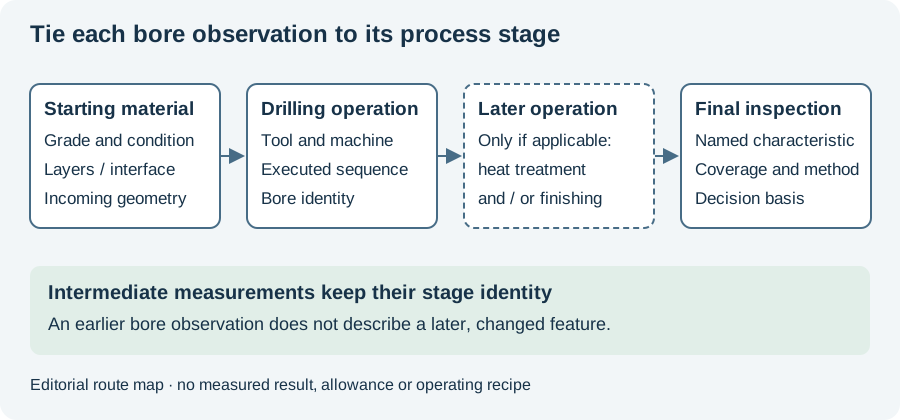
The material-route figure below connects the specified grade and apparatus to separate observations. Use the quality worksheet to define the responses for another component. Continue to the polymer evidence guide and micro-hole discussion for transfer questions; this paper supplies no verified PEKK result or universal polymer drilling recipe.
Revision note
October 8, 2026: revised the technical explanation and connected reading after source review. Original publication date and URL retained.