A dated, attributed case
TBT hosts a September 2016 mav report about a late-2015 job involving two tubesheets with 1,752 holes each. The article credits TBT sales manager Thomas Bruchhaus. It reports using Series 10 indexable single-lip tooling and claims approximately halved pure machining time, excluding ancillary time. Original German case report.
These are the manufacturer’s reported circumstances and results. We have not independently inspected the parts, production records or comparison baseline. This is archive coverage, not a 2026 production announcement.
Read the denominator
The claim concerns cutting time. Our editorial interpretation is that a complete purchasing decision also needs setting, changeover, inspection, tool-service time and rejected output. Those quantities must be reported separately before a cutting-time improvement becomes a total-cost conclusion.
The case discusses trials and a chosen application configuration. Copying one setting into another tubesheet job would skip the comparison of material condition, tool assembly, workholding and bore acceptance.
What the product page adds
TBT’s English Series 10 description describes the tool family. That page helps identify the product; it is not independent confirmation of the historical productivity result.
Questions for a comparable modern trial
Ask for an identified baseline, material batch, drawing, tool condition and accepted-hole count. Keep pure cutting time distinct from complete occupied machine time. Report insert and pad interventions, inspection and unsuccessful output.
Use a matched accounting boundary when comparing two offers. If one result excludes auxiliary operations, state that beside its percentage. These are our editorial comparison criteria, not additional findings from TBT’s case. The RFQ worksheet provides a place to request that evidence.
Two components can still contain many repeated holes
The historical report describes two tubesheets with 1,752 holes each. The small number of components should not be mistaken for a small number of repeated drilling operations. The hole population explains why a cutting-time comparison can be relevant even in a two-piece order.
TBT attributes the reported productivity improvement to its tool/application account. We have not obtained independent production records, and the historical result is not a current quotation or a verified saving on another tubesheet.
Keep the cutting-time denominator
If cutting time is halved while all other job time remains unchanged, the saving in complete job time depends on how much of that job was originally cutting. That is arithmetic interpretation, not an additional TBT finding. Setup, handling and inspection still belong to a complete comparison even when the reported headline concerns cutting alone.
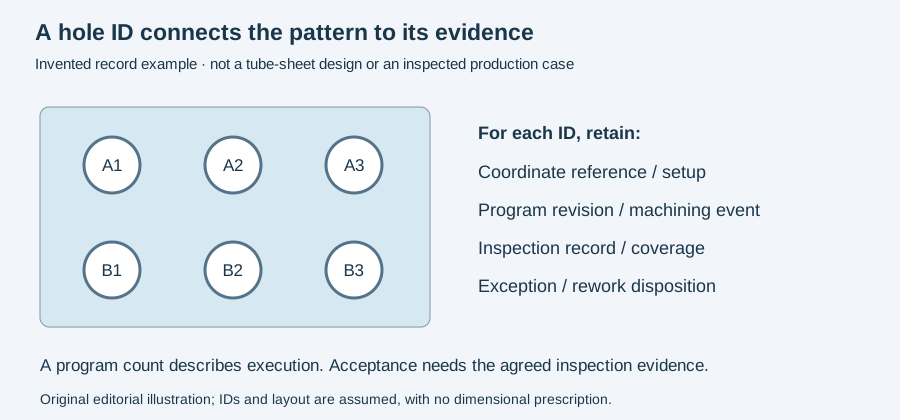
The hole-map diagram below uses an invented pattern to illustrate per-hole identity; it does not reproduce this customer’s drawing. Use the accepted-hole cost tool with actual quantities and a defined job boundary. The next readings connect tubesheet applications to repeated-hole planning without transferring the historical tool settings or claimed result.
Revision note
October 8, 2026: revised the technical explanation and connected reading after source review. Original publication date and URL retained.