BTA drilling of clad materials asks where the tool crosses a material interface and where the study checks the resulting bore. An original tube-sheet drilling paper provides detailed measurement stations, making it possible to examine those two questions separately.
The tube-sheet context and the test are distinct descriptions
Li and colleagues’ 2023 Materials paper describes an industrial tube-sheet context with Inconel 690 surfacing on one face. Its experiment uses a 17.75 mm BTA drill and an 800 mm-long specimen described in relation to that tube-sheet material.
That context is useful, but it does not establish that every later measurement samples the surfacing or the fusion zone. The paper’s methods must be read for their actual section positions.
The inspection stations are explicit
The researchers take sections at depths of 50, 200, 400, 600 and 800 mm. The work includes CMM examination of diameter, roundness and perpendicularity, longitudinal wall roughness observations, X-ray residual-stress measurement and near-surface hardness examination. Each of these is a different response.
The paper describes 8 mm surfacing in the industrial context, while the first listed section station is 50 mm. Those two positions cannot be treated as the same inspected zone. A bore-wall measurement deeper into the substrate does not automatically document the material transition near the face.
What this changes in interpreting the experiment
The published investigation connects operating inputs, tool wear and machining quality under its test conditions. It offers a concrete model of how to report spatially identified bore evidence. It does not supply a complete qualification record for a clad component simply because its introduction discusses one.
Our interpretation is to retain a coverage map beside a result table. Mark the interface, the section stations and which characteristic each station supports. If the transition itself is unobserved, the map makes that gap specific rather than labeling the whole investigation insufficient.
A newer paper is a reading lead, not a borrowed result
The publication identity of the 2026 Wear paper on BTA drilling of heterogeneous materials is verified. No wear-ordering or interface-behaviour finding is drawn from it here, so a comparison across the cladding interface still rests on the earlier tube-sheet experiment alone.
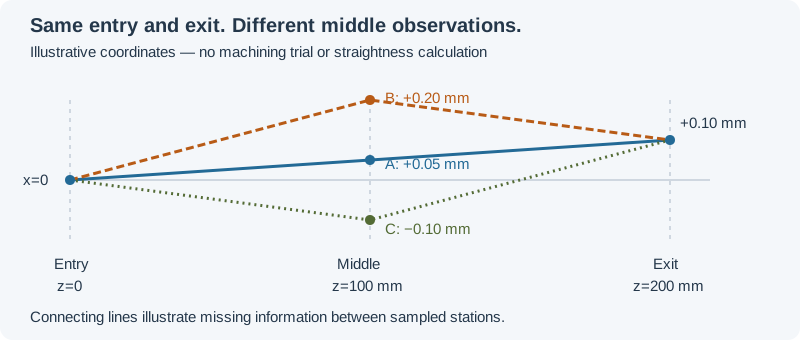
Use the bore-quality worksheet to record the material layers, interface location and observation coverage for an actual application. The figure below illustrates why isolated endpoint observations leave the interior unresolved. Continue to the dissimilar-material comparison for defining a matched experiment, or the surface-integrity reading for the difference between wall texture and near-surface material evidence.
Revision note
October 8, 2026: revised the technical explanation and connected reading after source review. Original publication date and URL retained.