CMC deep hole drilling searches often lead to cooling-hole research. The first task is to identify the hole feature and composite architecture before treating that literature as evidence for a long mechanically drilled passage.
The review covers several removal methods
Luo and colleagues’ 2024 publisher abstract reviews embedded holes in ceramic-matrix composite components. It considers mechanical, ultrasonic-assisted and laser processing, including defect formation and selection in relation to hole dimensions.
That is a literature-review scope. It does not describe one interchangeable tool system or establish that a conventional single-lip machine has produced the reader’s CMC bore.
Our comparison therefore keeps three questions together: what material was processed, how it was removed, and what damage or geometry was inspected. A method name without those details gives a poor basis for transferring a published result.
Material architecture affects what must be examined
Fraunhofer IWM’s German testing description identifies heterogeneity and anisotropy as reasons CMC characterization needs adapted tests. Its work concerns material characterization, not a universal hole-drilling acceptance method.
For a hole-making comparison, specify the fibre/matrix system, reinforcement architecture and orientation of the proposed bore. An external component name such as “aerospace composite” leaves these features unresolved. If inspection uses a section, retain the section orientation so the result can be related to the architecture being examined.
Compare the delivered feature across methods
Mechanical and laser proposals should be compared against the same required hole, including entrance, interior and exit where applicable. Record any finishing step before judging the delivered wall. If one proposal includes additional processing and another is judged immediately after drilling, their reported surfaces belong to different route stages.
The inspection plan should distinguish dimensional geometry from observed damage. A diameter within its drawing limit does not, by itself, document what a section or another damage-sensitive examination would show. Conversely, a surface image does not supply the unmeasured internal geometry.
These are editorial comparison principles. The readable abstract supplies no qualified CMC gun-drilling parameter set, and no matched single-lip production trial is available for this material.
What the connected pages provide
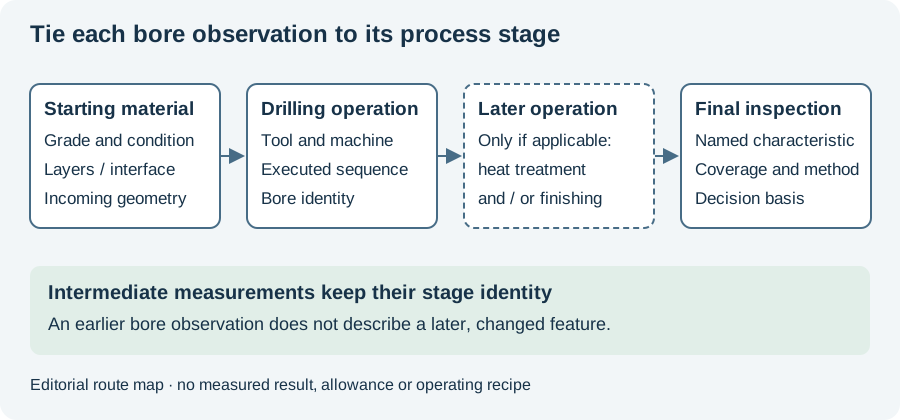
The diagram below places material state, removal and inspection in one route. Use the RFQ worksheet to describe the actual composite feature and the demonstration requested from each process candidate. Continue to EDM/laser method selection for the process distinction, or bore measurement for locating observations along the hole. Keep a proposal’s missing evidence visible until the matched experiment exists.
Revision note
October 8, 2026: revised the technical explanation and connected reading after source review. Original publication date and URL retained.