Aluminum deep hole drilling recommendations become ambiguous when the alloy and condition disappear from the record. A statement such as “use the aluminum setting” can refer to a supplier’s material category, a local trial or an assumption. Those are different starting points.
What the original tool table actually groups
The botek single-flute catalogue places aluminum alloys with silicon content above 5% in one Type 113 category and aluminum alloys below 5% silicon in a category marked “not hardened.” These are tool-specific recommendation headings. They do not establish a universal dividing line for machinability or permission to ignore the supplied condition.
Reading the heading is part of reading the parameter. A cutting speed detached from its tool family, diameter and material category is no longer the original recommendation. The catalogue also identifies drilling conditions, drilling length, coolant and machine/workholding rigidity as influences on selection.
Describe the return path, then observe it
For a single-lip gun drill, fluid is supplied through the tool and chips return along the outside flute. The accompanying circuit reading explains that architecture. It gives a concrete place to locate an evacuation observation: the discharge, a recovered chip sample or the bore wall.
An interrupted cycle and an inspected wall answer different questions. A clear discharge at the machine does not describe the complete interior geometry. Likewise, an undamaged entrance cannot show whether another part of the bore meets the drawing.
Our application interpretation is to connect each observation to depth and bore identity. If chip discharge changes after extending the same operation, retain both the successful shorter interval and the later change. That provides more information than marking the entire run “good” or “bad.”
Choose the measurement by the requirement
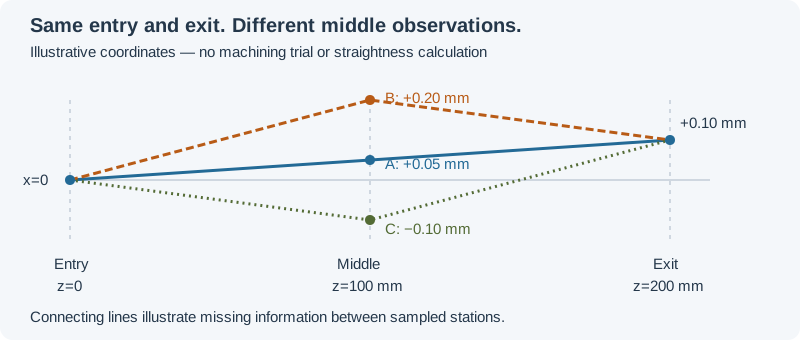
Diameter, roundness, axis location and texture need their own characteristic and coverage description. Define which of them matters before comparing a new setting with a reference. A measurement at one station can be useful while still leaving other stations unobserved.
The bore-quality worksheet helps make that distinction explicit. Record the named alloy and condition, the tool family, the drawing characteristic and the measured locations. Add chip observations as process evidence rather than using them as the acceptance result.
The figure shows why equal entry and exit observations can leave different interior paths unresolved. Continue to gun-drill geometry for the tool construction, or the measurement-method article for how inspection coverage affects a long-bore result. Neither continuation supplies an alloy-independent aluminum recipe; each develops a different part of the same machining decision.
Revision note
October 8, 2026: revised the technical explanation and connected reading after source review. Original publication date and URL retained.