Unusual-material deep hole drilling searches can return a microdrilling experiment, a deep polymer bore, a process review and a simulation. Putting all four under “difficult materials” does not make their evidence interchangeable. Their differences can instead guide the next reading.
NiTi: a small diameter is not the drilled aspect ratio
Khan and colleagues’ 2025 Scientific Reports paper uses a 495 μm carbide drill and a 500 μm drilled depth in low-carbon NiTi. The depth-to-diameter ratio is about one, calculated from those reported dimensions. It supplies microdrilling observations, rather than direct evidence for a long NiTi bore.
Its opening-diameter and wear observations also differ from a measurement of the complete bore axis. The dedicated Nitinol reading examines that distinction and a feed-unit conflict in the paper.
PEEK: the process extension is the valuable comparison
Nomura and colleagues’ 2022 original paper uses a 0.28 mm drill with externally applied cold gas. A cooled nonstep sequence that worked at the earlier depth developed wall damage when extended. The authors then combined an initial nonstep segment with step drilling.
The source is useful because it follows an unsuccessful extension as well as the changed sequence. It tests PEEK, so the result remains attached to PEEK and that cooling/tool arrangement.
CMC: a review identifies alternatives, not one tested recipe
The accessible abstract of Luo and colleagues’ 2024 CMC hole-making review distinguishes mechanical, ultrasonic-assisted and laser approaches. This is a map of processes to investigate. It does not provide this page with independently checked settings for conventional single-lip drilling in a named ceramic composite.
Fe–Mn–Al–C: a model asks a physical question
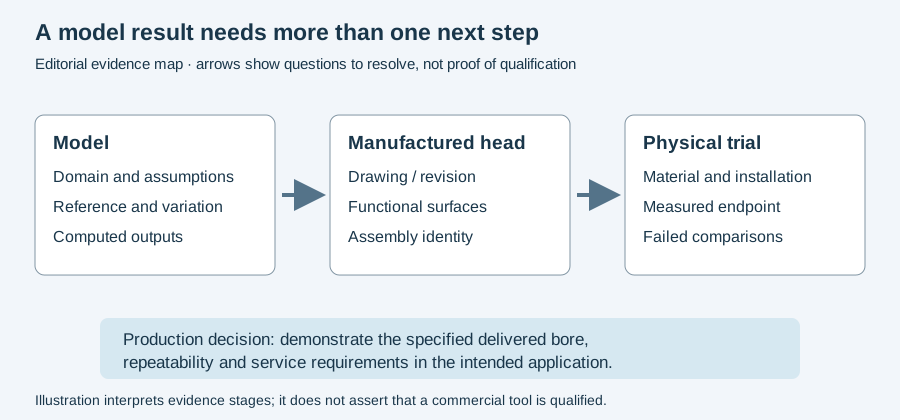
Sun and colleagues’ 2026 original abstract describes a three-dimensional finite-element gun-drilling analysis addressing temperature, axial force and exit burrs. An accessible simulation finding is not a matched physical confirmation. The accompanying model-to-trial diagram keeps that next step visible.
Choose the next article by the unresolved question
Our comparison uses four fields: actual process, drilled geometry, evidence type and observed response. These fields explain why copying the most attractive parameter from each material would lose the experimental question.
Use the unit converter only to reconcile named quantities, such as feed per revolution and linear feed; it does not select a material recipe. Then open the PEEK article for a depth-extension investigation or the Nitinol article for the distinction between specimen thickness and drilled depth. Those readings provide concrete examples of how the evidence map changes a machining decision.
Revision note
October 8, 2026: revised the technical explanation and connected reading after source review. Original publication date and URL retained.