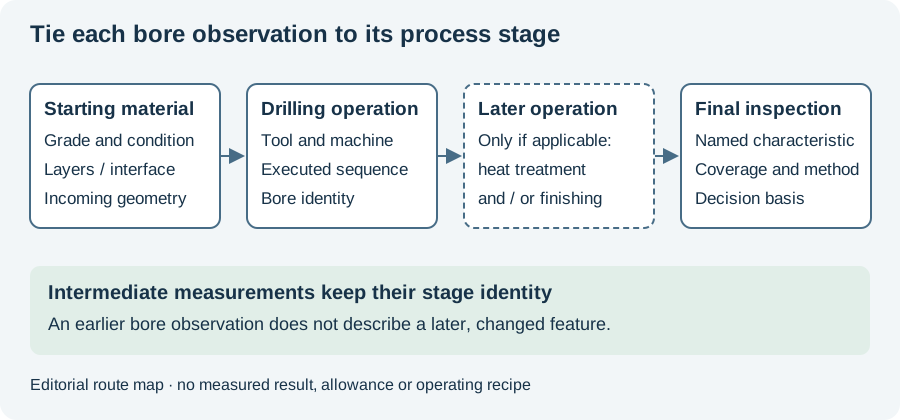
Hardened steel deep hole drilling involves two different route questions: drilling material that is already hardened, and drilling before a later hardening operation. Mixing them can leave the reader unsure which stage a measured bore represents.
Heat treatment can change the feature after machining
Uddeholm’s heat-treatment guide, edition 9 of October 2017, discusses machining, thermal and transformation stresses and their contribution to dimensional change. It describes machining allowance and the position of stress relief within a tool-steel processing route.
Its German dimensional-stability article distinguishes changes in volume from distortion of shape and discusses the role of retained austenite in later dimensional change. These are producer explanations of tool-steel behavior; they do not provide a universal allowance for every bore.
The immediate application question is concrete: was the bore inspected before or after the operation that may change it? A report with no stage identity cannot answer that question merely by giving more decimal places.
Already-hardened stock is a different starting point
The botek single-flute catalogue includes hardened steel within named material recommendation groups. The presence of that category does not establish one hardness envelope for every tool construction, diameter and drilling length.
For already-hardened stock, preserve the actual supplied state and the selected tool family. For a pre-hardening bore, describe any later heat treatment and finishing operation. Those routes may serve the same drawing feature while exposing it to different subsequent operations.
Place the requirement at the appropriate stage
Our editorial interpretation is to use intermediate measurements for what they actually show. A pre-treatment measurement can document incoming geometry for the next operation. A post-finishing measurement can support final acceptance if its characteristic, coverage and decision basis match the requirement.
The earlier observation remains useful; it simply answers a different stage question. Linking both records under one feature ID makes a route change visible rather than losing it in separate inspection reports.
Finish the route before choosing the comparison
The process specification worksheet records the starting material and required bore. Add the applicable heat-treatment and finishing stages explicitly; it has no built-in generic shrinkage or allowance rule. The diagram below includes those later operations only when they belong to the actual route.
Continue to the measurement-method article to distinguish coverage from a reported value, or the material-state surface-integrity reading to see how a research experiment identifies a prepared specimen. The useful outcome is a bore result tied to its physical stage, not a free-standing claim that hardened-steel drilling is possible.
Revision note
October 8, 2026: revised the technical explanation and connected reading after source review. Original publication date and URL retained.