Stainless steel deep hole drilling starts with a more specific material description than “stainless.” The original botek single-flute catalogue separates stainless groups within its Type 113 recommendations. That separation changes which row a reader should consult before considering a setting.
The table distinguishes composition and condition
The botek catalogue lists ferritic and martensitic stainless with 13–25% chromium and a sulphurized condition separately from an austenitic group with more than 8% nickel and 18–25% chromium. These are the manufacturer’s table categories, not a complete classification of every stainless grade.
The headings also belong to a named tool family. Moving the numbers to a different head or coating removes part of the recommendation’s context. Record the steel designation, supplied condition and actual tool before looking for a comparison. If the material does not match the stated group, the table has not resolved the selection.
A 304 paper asks a narrower question
Jiang and colleagues’ 2025 TNUAA paper concerns gun drilling of 304 stainless. Its accessible abstract describes force and roughness investigations followed by SEM/EDS examination of tool wear and a proposed regrinding strategy.
This establishes the paper’s research sequence. The complete experimental geometry and regrind criteria could not be checked through the available full-text links, so the abstract does not supply this page with a production recipe. The dedicated 304 article follows the wear-study question in more detail.
Chip behavior and wall condition can tell different stories
The Deutsche Edelstahlwerke/TU Dortmund brochure, pages 10–13, compares sulphur variants in other engineering steels using deep-drilling tests. Its reported chip and wear differences were not accompanied by equally pronounced differences in bore quality. Those experiments are adjacent evidence, rather than a matched 304 comparison.
The useful editorial lesson is to keep the responses separate. A chip sample can explain an evacuation problem; a tool image can locate wear; a wall measurement can assess a drawing characteristic. None substitutes for the other merely because they came from the same drilling run.
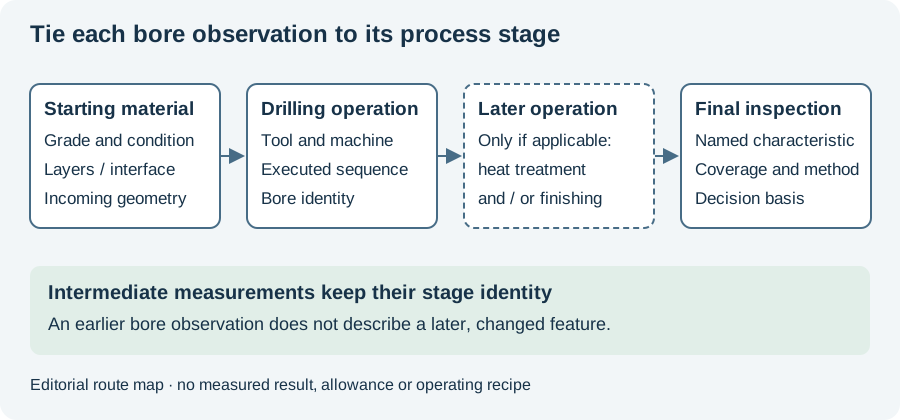
For a stainless trial, put those observations under the same bore ID and retain the material certificate description. The incident record is useful when the question concerns a change during drilling. For a completed bore, state the inspection locations and characteristic separately. The diagram below places inspection after the identified material and machining route; the next readings develop the specific 304 study and the gun drill’s fluid circuit.
Revision note
October 8, 2026: revised the technical explanation and connected reading after source review. Original publication date and URL retained.