A dissimilar-material deep hole drilling comparison needs an interface description. “Steel and nickel alloy” identifies constituents but leaves out their order, thickness and the tool’s direction of travel. Those details determine what an interface comparison actually compares.
Start with the specimen, not the headline result
The 2023 SA-5083 BTA paper describes a tube-sheet application with Inconel 690 surfacing and then reports a controlled drilling investigation. Its explicit section stations provide a useful example of spatial reporting. They also show why the industrial context should be kept separate from the actual measurement coverage.
For a proposed comparison, sketch the layers along the drilling direction. Give the interface a position in the same coordinate system as the bore observations. Record whether the drilling begins in the surfacing, the substrate or a pre-existing hole. This is our editorial comparison framework, rather than a parameter recommendation from the paper.
Hold the finished task steady
Two operations can be compared meaningfully only after the required feature and output unit are stated. A solid-drilling pass and an operation through a prepared bore may have different starting tasks even when the final diameter agrees.
The BTA-Tiefbohrsysteme tool descriptions show named head families and material-related insert selections. A comparison should preserve the selected head and inserts, rather than reducing the complete assembly to “BTA.” The manufacturer description does not itself establish a matched clad-material trial.
Keep observation types in their own columns
The 2023 experiment uses diameter, geometric, texture, residual-stress and hardness observations. A diameter measured in the substrate answers a different question from a section through the interface. A roughness result does not stand in for near-surface metallurgical evidence.
If one method has a transition-section examination and another has only entry and exit readings, label the difference in coverage. Calling both “bore quality checked” would conceal the most consequential difference in the comparison.
Include later operations when they belong to the route
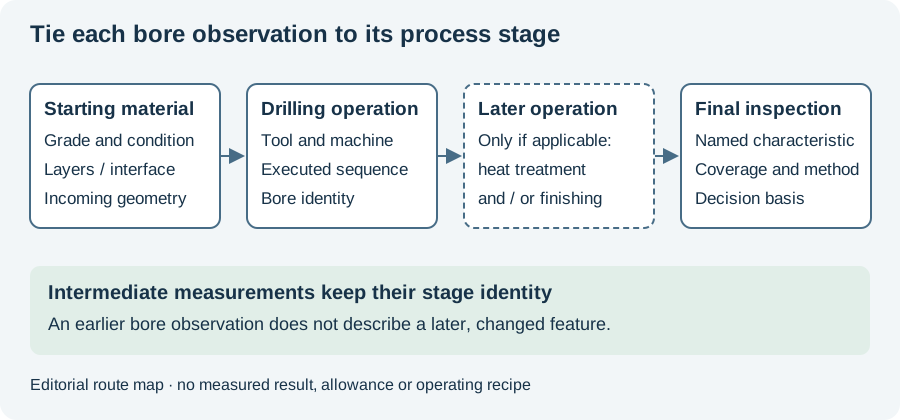
If the compared bores undergo subsequent finishing or thermal processing, retain the stage of each measurement. A machining observation and a final-acceptance result can both be useful, provided their identities remain visible. The route diagram below places any applicable later operation before final inspection.
Use the process specification worksheet to define the starting geometry and required feature. Continue to the companion clad-BTA article for the original experiment’s section locations, then the measurement-method reading for coverage and evaluation. The accessible identity of a newer 2026 heterogeneous-material paper remains a research lead; its unverified full-text findings do not fill a missing comparison cell.
Revision note
October 8, 2026: revised the technical explanation and connected reading after source review. Original publication date and URL retained.