A Nitinol deep hole drilling decision needs both the diameter and the actual drilled depth. An accessible 2025 NiTi study helps explain why a small drill or a thick specimen does not automatically establish deep-hole evidence.
First separate the three dimensions
Khan and colleagues’ original paper investigates a low-carbon NiTi material, a 495 μm tungsten-carbide drill and a fixed drilled depth of 500 μm. The specimen thickness is 5 mm. The drilled depth, rather than that stock thickness, belongs in the aspect ratio.
Converting the two relevant dimensions to millimetres gives 0.500 / 0.495, approximately 1.01. This is our arithmetic using the paper’s dimensions. Calling that experiment a long deep-hole demonstration would change its scope.
The measured responses have different purposes
The nine speed/feed combinations investigate opening diameter, machining time and tool condition. The paper uses microscopy for hole observations and SEM/EDS for the tool. A diameter measured at the opening does not document geometry along a much longer proposed bore.
That distinction changes the follow-up question. Rather than asking whether the study “works on Nitinol,” ask which response has been measured for which material, drill and depth. For a long bore, identify the extra inspection locations and the missing evacuation evidence.
Check units before importing the time calculation
The methods label traverse feed in mm/min. Equation 1 divides hole length by spindle speed multiplied by that feed. With those stated units, the denominator is not a linear feed speed. The equation therefore cannot be adopted unchanged as a drilling-time calculation.
This dimensional check does not revise the authors’ recorded observations. It separates a published calculation from measurements and prevents an ambiguous expression from becoming a shop estimator. If feed is already a linear rate, ideal engaged travel time is length divided by that rate; if feed is per revolution, conversion requires rotational speed. Retracts, pauses and other motions need their own time record.
What would support the longer bore?
A suitable next experiment would retain the actual NiTi composition and supplied state, then reproduce the proposed diameter, drilled length and tool architecture. It would associate tool inspection with successive identified bores and inspect the required wall and geometric characteristics. That is an editorial proposal, not a result of the short microdrilling study.
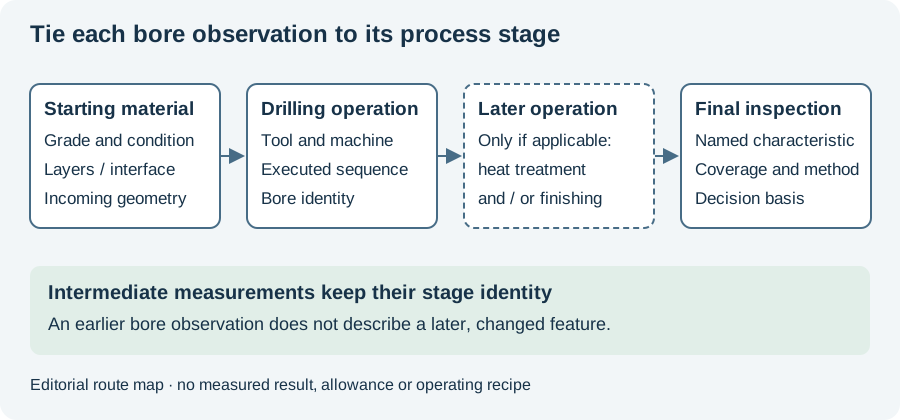
The comparison diagram locates material state, machining and inspection in the route. Use the conversion tool to keep micrometres, millimetres and feed quantities distinct. Continue to bore measurement for coverage along a hole, or the unusual-materials overview for comparing research scopes.
Revision note
October 8, 2026: revised the technical explanation and connected reading after source review. Original publication date and URL retained.