PEEK deep hole drilling provides a useful example of two process problems interacting. In Nomura and colleagues’ 2022 experiment, cold-gas cooling improved the initial drilling result, but extending the cooled, continuous operation exposed another problem at the bore entrance.
The experiment used external cooling
The original paper uses TECAPEEK, a 0.28 mm ATOM drill and a vertical NC milling machine. Cooling spray was applied manually from the side of the workpiece. Four drilling repetitions were made under each condition. This was not a test of a conventional internally supplied gun drill.
The observations include thrust, chips, entrance burrs, hole position and wall texture. Cooling reduced burr height in the tested comparisons, while its effect on hole position was negligible. “Accuracy” therefore needs a named response.
Extending the depth changed the problem
The authors extended cooled nonstep drilling beyond the earlier 3 mm depth. At 4 mm and deeper, wall damage appeared. They observed chips densely adhering to the drill grooves and proposed that cooling near the entrance promoted accumulation during chip discharge.
They then combined nonstep drilling to 3 mm with 0.2 mm steps toward a 5 mm depth, returning the tip to the entrance during the step sequence. The paper reports improved wall condition under that combined sequence.
Why this result is useful beyond a parameter table
Our reading of the experiment is that the cooling arrangement and evacuation cycle must be assessed together. A change can address a thermal problem while changing what happens elsewhere along the chip path. That is why inspection along the bore is more useful than a photograph of an undamaged entry alone.
It also explains why adopting only the opening result would miss the article’s engineering contribution. The later phase shows what happened when the authors extended the process, inspected the damage and changed the sequence. A trial report should retain unsuccessful extensions as well as the final comparison.
PEEK evidence remains PEEK evidence
PEKK, reinforced PEEK and another supplied stock require their own material and process description. Neither this paper’s cooling method nor its step distance establishes their operating procedure. The specimen and tool architecture are part of the result, not incidental details to discard when transferring it.
For a polymer trial, define the inspection stage and measurement locations before machining. Record cooling delivery, programmed sequence, recovered chips and wall observations under the same bore identity. The incident worksheet can capture the point at which an apparently successful sequence began to damage the wall.
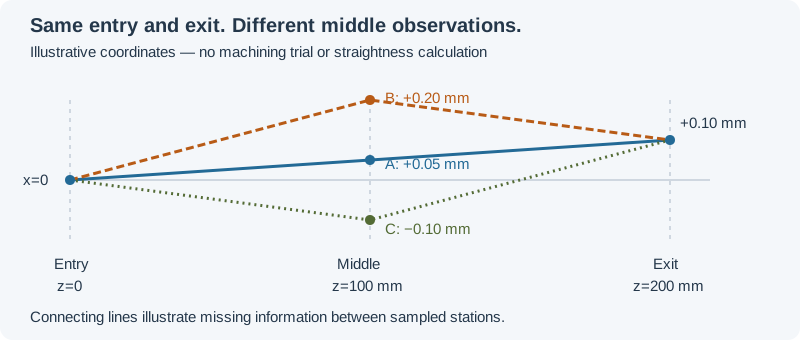
The figure below distinguishes coverage along the bore from endpoint observations. Continue to the archived PEEK paper reading for its apparatus, or the chip-blockage investigation for recording a depth-dependent event.
Revision note
October 8, 2026: revised the technical explanation and connected reading after source review. Original publication date and URL retained.