Single-part production poses a monitoring question before identical reference parts exist: which signal changes belong to the selected drilling cycle, and which indicate a critical event? AutoBohr’s public completion report addresses that question. It does not publish a universal acceptance method for gun-drilled or BTA components.
The completion report and its scope
In its April 1, 2026 announcement, IFW reports completing AutoBohr with iba AG. The described system first identifies drilling phases, then evaluates the corresponding process signals using historical data and neural-network methods. IFW reports production testing at a contract manufacturer and detection of events including tool breakage.
The German announcement provides the corresponding institute account. These are attributed project outcomes. The announcement does not expose a numerical missed-event or false-alarm breakdown, and it does not identify qualified coverage for every deep-hole process.
Phase recognition changes the comparison
As an editorial illustration, a signal step at the start of engagement and a similar step during established cutting occur in different cycle contexts. A phase-aware proposal should retain which context its decision used. Otherwise a later investigation cannot distinguish an unusual event from an incorrectly assigned phase.
Keep cycle segmentation and anomaly interpretation separately inspectable. If a record contains only the final alarm, it cannot show which phase was identified or which underlying observation led to the decision.
A new bore needs an application assessment
Identify the proposed installation’s tool, material, depth range, signals and cycle variants. Ask which of those conditions appeared in the demonstrated work and what remains to be assessed. “New part” is not a substitute for naming the conditions that differ from prior validation.
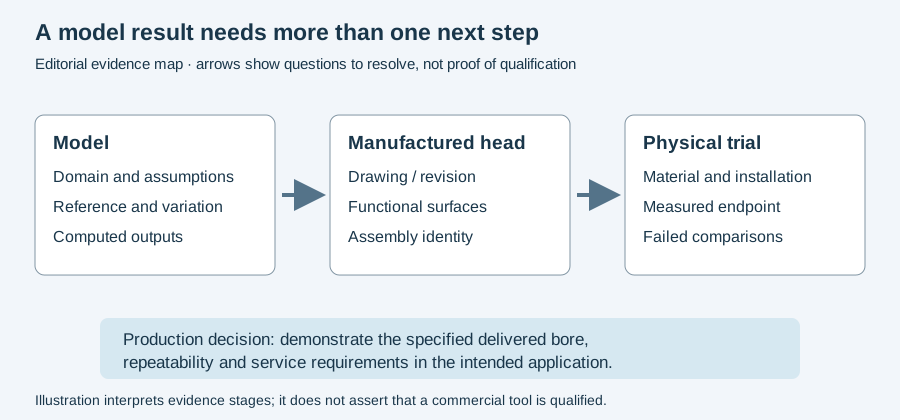
The model-to-trial diagram below separates the research description, candidate installation and inspected outcome. It is an editorial evaluation path, not a claim that the institute completed those steps for the reader’s machine.
Decide what an alarm is allowed to do
Detecting an anomaly, initiating an approved machine response and accepting a delivered bore are distinct decisions. Evaluate the proposed response through the applicable machine procedure and retain the independent bore-inspection endpoint. A monitoring record can help explain an event without replacing the drawing’s acceptance evidence.
Use the incident worksheet for signal and event identity. Continue to monitoring for performance assessment, or to the roughness-model article for the different task of predicting a surface-related class.
Revision note
October 8, 2026: revised the technical explanation and connected reading after source review. Original publication date and URL retained.