Agree the scope before making the first part
Identify the customer’s required inspection format and actual applicable specification. This page provides an editorial report structure; it does not establish compliance with an aerospace or other sector standard, a mandated sample count, or a certification requirement.
Record which delivery stage is being examined. An as-drilled trial, a finished bore and a complete delivered assembly are different report scopes. Mark operations still to come instead of presenting their results as already verified.
Make one row per required characteristic
| Report field | Example of the information type |
|---|---|
| Characteristic identity | Drawing note or marked feature identifier |
| Requirement | Exact limits, units, datum and reference |
| Coverage | Depth, locations, directions and sampling agreed for the job |
| Method | Instrument/probe, fixture, procedure and evaluation settings |
| Result | Actual value and report/raw-record reference |
| Decision | Agreed rule, disposition and responsible reviewer |
These are field descriptions, not example shop-floor results. Separate size, geometry, texture and other required examinations. A blank row means missing evidence, not a pass.
Tie the result to the process actually used
Retain part and material identity, supplied condition, tool/service history, machine/setup, program revision and finishing sequence with the report. Record approved deviations and the difference between the trial configuration and the proposed production configuration.
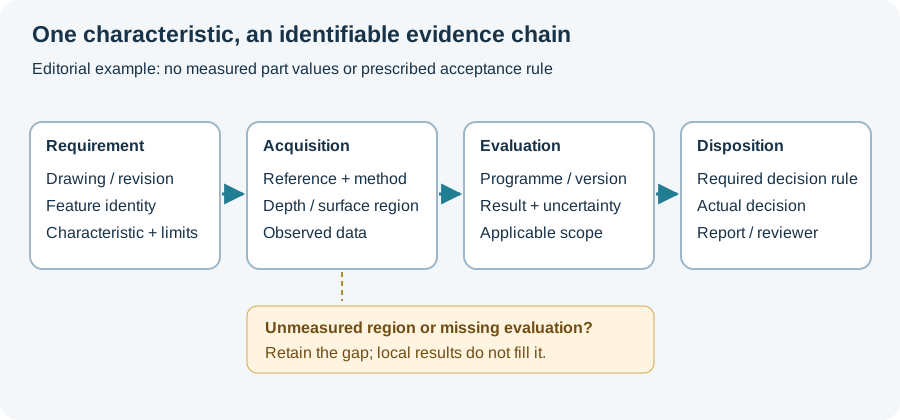
If an inspection location cannot be reached, identify the unexamined region and obtain an agreed resolution. Do not silently replace the intended characteristic with a convenient proxy. Review measurement coverage and uncertainty together.
Close open items explicitly
For each failed, missing or disputed result, record the nonconformance reference, proposed disposition, responsible party and actual decision. Do not label a form complete while an acceptance requirement is unresolved. The customer/site’s agreed release procedure determines authorization; this article does not grant it.
After a later tool, drawing, material or setup change, use the applicable change-control requirements to determine whether and what to reinspect. This page supplies no universal trigger list that overrides those requirements.
Use the bore-quality worksheet to prepare the inspection scope. Preserve the actual report separately; the worksheet is not a substitute for results or approval.
Publicly verified standard scope
IAQG’s 9102 introduction describes a standardized FAI process and documentation framework, primarily for aviation, space and defense, with possible use elsewhere. DIN Media lists DIN EN 9102:2025-01, the German and English version of EN 9102:2024, as current on October 8, 2026. Its public introduction states that the requirements complement customer and other applicable requirements.
These public pages establish scope and catalogue identity; they do not contain the normative clauses themselves. Use the contract’s controlled edition and required format for the actual report. The editorial table above helps prepare the information, but is not an assertion that filling it in demonstrates conformity to every clause.
The diagram below follows a named characteristic through acquisition, evaluation and disposition. A first-article report needs that complete connection even when several instruments or outside operations contribute separate records.
Revision note
October 8, 2026: revised the technical explanation and connected reading after source review. Original publication date and URL retained.