Deep hole measurement uncertainty belongs to a defined result obtained under stated conditions. A display increment describes one property of an instrument. It is not an uncertainty budget for a bore diameter, an axis result or a texture parameter.
Define the result before its budget
For a local diameter result, identify the depth, method, reference and measurement conditions. An uncertainty evaluation for that result does not automatically cover an unmeasured middle section or a different geometric calculation. Keep the scope of the value and the scope of the uncertainty aligned.
The GUM’s chapter 5 combines standard uncertainties through a measurement model. Its simple root-sum-square form applies to uncorrelated additive contributions with unit sensitivity coefficients; significant correlations require a different evaluation. A list of numbers without that model leaves the combination unexplained.
An intentionally assumed arithmetic example
Suppose a tutorial model for one diameter result has the following standard uncertainty contributions, already expressed in micrometres of the reported diameter. Assume they are uncorrelated and additive with sensitivity coefficients of magnitude one.
| Assumed contribution | Standard uncertainty |
|---|---|
| Reference contribution | 1.0 µm |
| Repeatability contribution | 1.5 µm |
| Residual condition/correction contribution | 2.0 µm |
These are invented teaching inputs, not values measured on a particular gauge. Under the stated model:
1uc = sqrt(1.0² + 1.5² + 2.0²) = 2.693 µm
2For an explicitly chosen example factor k = 2:
3U = k × uc = 5.385 µm
Chapter 6 distinguishes expanded uncertainty from the combined standard value. Choosing k=2 for this example does not prove an exact coverage probability for a real application. The report must state how its factor and coverage interpretation were obtained.
What the example leaves out
The calculation assumes its inputs already are standard uncertainties. A calibration certificate’s expanded uncertainty cannot be inserted unchanged into a column of standard values. It also assumes no omitted contribution, no significant correlation and the stated sensitivity coefficients. Those assumptions need justification in an actual evaluation.
Repeated readings on one master may share reference-related influences; more readings do not by themselves remove those influences. The relevant question is which effects the model represents, how their inputs were evaluated and whether the conditions match the measurement being reported.
Read a borderline result with its decision rule
Now assume a hypothetical result of 20.022 mm, using U=0.005385 mm from the tutorial budget. Its expanded interval would extend from about 20.0166 to 20.0274 mm. Against the illustrative upper size limit of 20.025 mm, the displayed estimate lies inside while part of that interval extends beyond it.
That observation alone does not prescribe an acceptance or rejection rule. It shows why the agreed decision rule must accompany a borderline result. Retain the requirement, uncertainty statement and decision record together.
Use this example to question a report’s structure, not to set a universal uncertainty-to-tolerance ratio. For a new bore, establish its measurement arrangement and evaluated region before borrowing another job’s budget.
A new result needs its own model scope
The GUM’s correlation discussion identifies common instruments and references as possible shared influences. A comparison involving two results should therefore retain which inputs they share. Treating both results as independent simply because they appear in separate report rows can omit that relationship.
The tutorial budget above applies to its assumed single diameter result. A difference between diameters, a fitted axis or a merged inspection from two fixtures is a new output quantity, with a model appropriate to it. Reuse the underlying source information where applicable, rather than copying the final uncertainty unchanged to the new output.
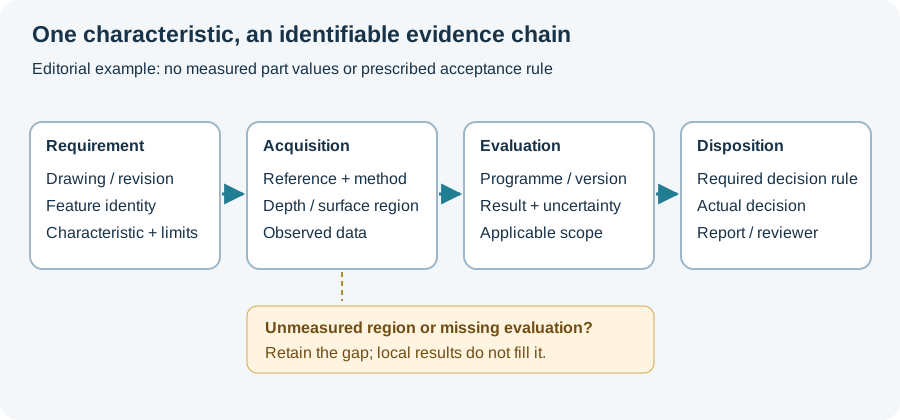
The figure below places the uncertainty statement beside the evaluated result and disposition. It does not prescribe a guard band or supply a calibrated budget for an actual bore.
Revision note
October 8, 2026: revised the technical explanation and connected reading after source review. Original publication date and URL retained.