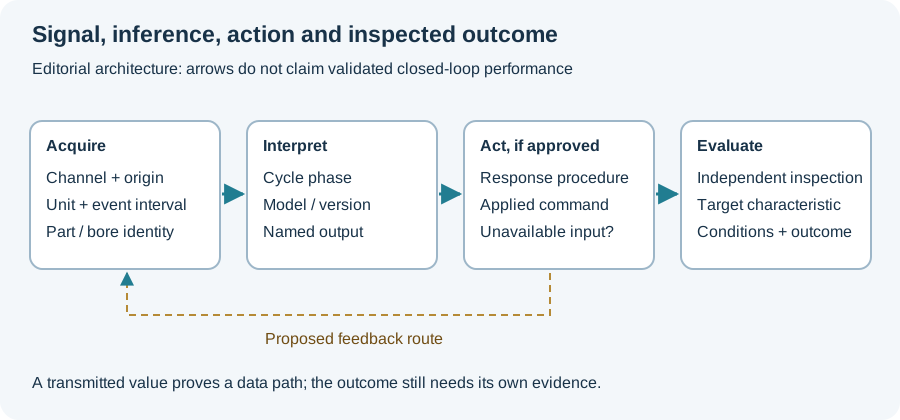
A feedback proposal needs to name both the quantity supplied to the controller and the quantity it intends to change. A measured diameter and a model’s predicted material-property state are different feedback inputs, even when both arrive during a machining cycle.
Direct measurement and inference differ
Novacam’s bore-metrology description presents optical acquisition and evaluated bore results. That architecture does not establish that a particular installation measures while the cutting edge is engaged or performs successful autonomous correction.
A proposal using machine signals to predict another property needs to expose that inference separately. Otherwise the report can misleadingly present a model output as a directly acquired dimensional reading.
A sensor-integrated research example
The 2024 Production Engineering paper presents a sensor-integrated single-lip tool and a regression soft sensor for a subsurface-quality description. The proposed controller uses that predicted state; it is not direct in-cut gauging of the bore diameter.
Section 3.4 explicitly places experimental determination of controller transfer functions and subsequent testing in the outlook. The paper’s reported sensor and model work should therefore remain separate from those proposed closed-loop steps. No completed production correction benefit is inferred from the controller schematic.
Follow the complete loop
The diagram below separates acquisition, inference, proposed action and independent outcome evaluation. For an actual proposal, identify the measurement or model version, timestamp, controlled variable and applied command. If the input is unavailable or outside its valid scope, retain that state rather than treating it as an ordinary value.
As an editorial example, a command change made after a model indication and a later acceptable diameter do not, on their own, establish that the model predicted diameter or that the correction caused the result. The proposed quantity and the inspected endpoint need to match the claim being assessed.
Validate the result separately from connectivity
Receiving a signal at the controller demonstrates a data path. A record of an applied command demonstrates an action. Successful control requires the relevant outcome evidence under identified conditions. Those stages should not collapse into a single claim that the system is “connected.”
Use the technical-review proposal to define an expert review of the control proposal and its unresolved validation questions. Continue to measurement uncertainty for the evaluated result or process monitoring for the different question of detecting an event. This article supplies no unverified control law, response-time guarantee or automatic acceptance rule.
Revision note
October 8, 2026: revised the technical explanation and connected reading after source review. Original publication date and URL retained.