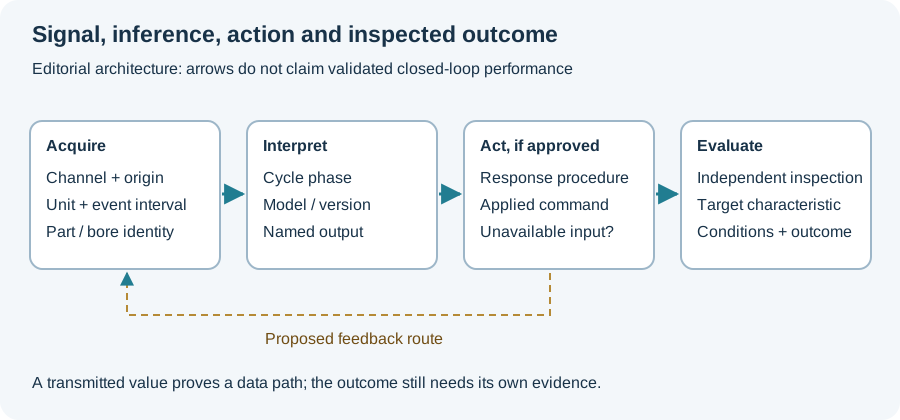
In-process monitoring observes a machining event. Bore inspection evaluates the resulting component. Connecting the two requires consistent part, hole and time identity; neither an alarm nor its absence supplies every drawing result.
Keep the signal’s origin visible
Identify whether a channel comes from a physical sensor, a controller estimate or a later calculation. Retain its unit, location and event interval. A label such as “load” without that origin can describe different quantities on different installations.
OPC UA for Machine Tools defines a machine-monitoring and job-management information model. That scope helps describe a data interface. It does not validate a quality classifier, the meaning of an installation’s threshold or the bore’s acceptance.
The cycle phase is part of the observation
IFW’s AutoBohr completion report describes phase-dependent evaluation of drilling signals and reports production testing. Its new-part monitoring claim remains attributed to the institute; the public account supplies no universal quantitative performance breakdown for deep-hole processes.
As an editorial illustration, an observed signal jump during engagement and one during established cutting belong to different contexts. Retain the identified phase with the signal and decision so the investigation can examine both the segmentation and the anomaly interpretation.
Define the performance endpoint
A tool-breakage detector and a surface-class predictor have different target events. For the proposed detector, identify how an event is independently confirmed and how its time is compared with the alarm. For a surface claim, connect the prediction to the inspected surface region and specified parameter or class.
Retain missed events, false indications and output that was not inspected. Do not count an uninspected no-alarm run as a confirmed correct quality decision. A performance assessment also needs its applicable population, not only the favorable alarms selected for demonstration.
Separate detection from the response
The monitoring-feedback diagram below distinguishes signal acquisition, inference, action and later evaluation. An approved stop or adjustment is a separate machine decision from event detection. The resulting bore still needs the applicable inspection and disposition.
The incident worksheet connects the trace, event and inspected feature. Continue to AutoBohr for the particular research announcement or feedback control for proposals that act on an inferred state. The article makes no universal threshold or automatic delivered-part acceptance claim.
Revision note
October 8, 2026: revised the technical explanation and connected reading after source review. Original publication date and URL retained.