Diamond and Roller Burnishing: Contact Arrangement Before Material
Distinguish a sliding fixed diamond from a rolling contact, then compare identified tool systems against the same inspected surface requirement.
Understand skiving and roller burnishing as separate cutting and surface-forming stages, including the incoming bore-path limitation.
ECOROLL’s German cylinder-tube article, dated October 17, 2024, describes skiving followed by roller burnishing. Skiving removes material; rolling plastically works the surface. Its English OMEGA system description explains the radially floating cutter concept. These are manufacturer explanations of the stated system.
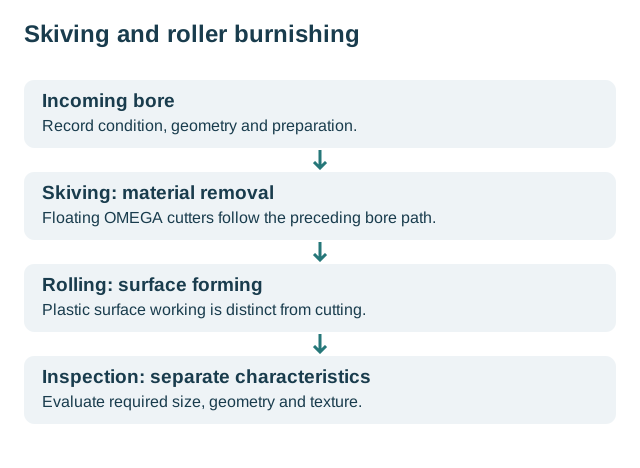
Editorial sequence diagram, not a dimensional tool drawing. No allowances or process settings are implied.
The German article explicitly says that the floating OMEGA arrangement follows the preceding bore path and cannot correct that path. A surface-finishing claim therefore does not answer a question about straightness. Read the bore-path analysis before interpreting a product’s surface claim as complete geometric correction.
Our editorial consequence is to divide an evaluation into the incoming bore, the cutting stage, the rolling stage and the final measurements. That division keeps a successful texture result from closing an unresolved geometric requirement.
| Stage | Evidence to retain | Reading route |
|---|---|---|
| Incoming bore | Stock condition, measured geometry and remaining preparation | OMEGA tool geometry |
| Selected process | Named tool system, machine interfaces and maker’s application record | Skiving and burnishing articles |
| Delivered bore | Results for each required characteristic and covered location | Quality and inspection |
An offer described as “skiving and burnishing” still needs a definition of what enters and leaves the operation. Use the RFQ worksheet to state blank supply, included preparation, finishing, cleaning and inspection. Ask the supplier to identify excluded work and unresolved drawing requirements explicitly.
For a trial, record actual machining and inspection observations separately. A copied catalogue setting is not evidence that the proposed component has met its requirements. Cost comparison should use the same defined batch boundary and actual accepted output, with no duplicate charges hidden inside the hourly rate.
The articles below explore particular tools and evaluation questions. Product descriptions remain tied to their documented constructions; the mechanism overview above is the starting point for selecting which article answers your job’s question.
Choose your next step
Choose the question you are working on. These links organize the library; they are not machine operating instructions.
Start with the process
Skiving and Roller Burnishing: Two Operations, Different Cycles →Compare finishing methods
Bore Finishing Method Selection: Choose the Remaining Task →Prepare tools and setup
Skiving and Burnishing Setup: References and Separate Circuits →Review surface integrity
Roller Burnishing Surface Integrity: Texture and Subsurface Evidence →Investigate problems
Skiving and Burnishing Troubleshooting: Locate the Defect in the Route →Distinguish a sliding fixed diamond from a rolling contact, then compare identified tool systems against the same inspected surface requirement.
Compare named skiving and roller-burnishing cycles by forward and return tasks, setting freedom and the complete inspected-output interval.
Compare SRB and honing using the same incoming bore, functional surface requirements, trial results and complete processing cost.
Understand material removal and surface forming, then distinguish combined forward treatment from separately sequenced skiving and rolling.
Read the documented OMEGA cutter support, optional stages and control interfaces together with the stated prior-bore-path limitation.
Separate incoming geometry, cutting-stage results, rolling-stage results and return events before selecting a supported investigation.
Compare preparation, active strokes, tool service and inspection using the same accepted-output boundary.
Connect a cylinder sealing-surface requirement to incoming geometry, named finishing stages and independently identifiable final inspection.
Compare cutting, abrasive finishing and surface forming by the incoming bore and the characteristic the complete route must deliver.
Read the HG tool and pressure-supply arrangement as one system, while keeping surface measurements and material-property claims separately evaluated.
Distinguish the inspected surface texture from hardness, residual stress and component performance when reviewing a burnishing claim.
Review the documented skiving/tool-change/burnishing sequence against the actual lathe, holder, access and delivered inspection scope.
Evaluate a large-bore proposal through the named tool assembly, control system, travel/access envelope and report coverage.
Separate cutting and rolling settings by the named tool cycle, and distinguish a selected application value from spindle/feed conversion.
Identify workpiece and tool references, then separate process-fluid supply from the selected tool-control arrangement.
Evaluate skiving stock allowance against the incoming bore, selected tool stages and required final geometry; avoid a universal allowance value.