Select a bore-finishing route from the remaining requirement. A bore that needs material removed, a specified surface structure and a datum-related result presents several tasks. One attractive roughness number does not describe how all of them will be delivered.
Identify the operation’s mechanism
Sunnen’s process overview describes honing with abrasive stones, rotation and reciprocating motion. ECOROLL’s cylinder account describes skiving material removal followed by plastic surface working. These mechanisms are different; their names should remain attached to the proposed operations.
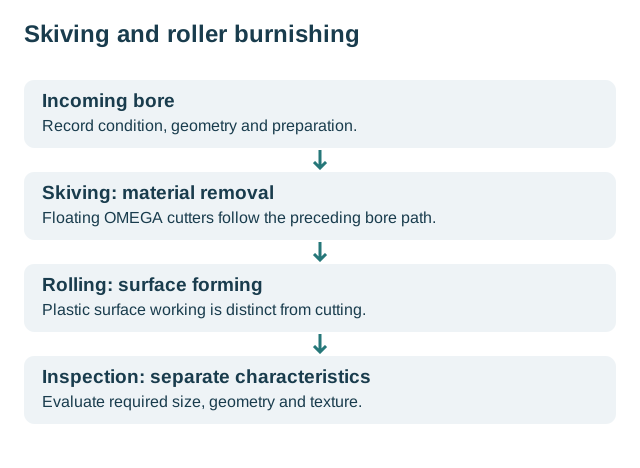
The stages diagram below depicts the latter route. It is not a claim that a forming operation removes the stock assigned to cutting, or that every finishing route uses those stages.
Put the unresolved characteristic first
For an assumed part, the starting report may show acceptable size but leave the required texture unverified. Another part may have a measured size outside the requirement. The selection question differs between them, even if the final nominal diameter is identical.
Identify the incoming and final component states. If additional material removal is proposed, state which operation performs it. If an axis-related requirement remains open, obtain the route’s applicable geometry evidence instead of inferring it from a surface claim.
Guidance architecture can limit the geometry task
Gehring’s honing explanation describes an articulated, self-centering arrangement that adapts to bore position and inclination; it also names rigid position-honing as an exception. ECOROLL describes its floating skiving arrangement as following the prior bore. Neither statement supports a rule that every tool in the process category has the same corrective scope.
Ask for the actual head, mounting and access arrangement. A method name alone cannot resolve blind ends, interruptions or the unprocessed region near an end.
Compare the delivered route
Retain preparation, processing, handling and inspection for each candidate. Compare results for the same requirement and input state. Supplier economic claims need matched application evidence before being used as a conclusion about the reader’s component.
The RFQ worksheet makes that scope explicit. Continue to SRB versus honing for the narrower comparison, or secondary operations for assigning tasks across a multi-operation route. There is no universal best method or price crossover in the reviewed public descriptions.
Revision note
October 8, 2026: revised the technical explanation and connected reading after source review. Original publication date and URL retained.