Hydrostatic deep rolling needs an identified rolling element and its supply arrangement. A tool-family name alone cannot tell whether the proposed assembly reaches the required contour or delivers the claimed material-property change.
Read the configuration designation
ECOROLL’s HG pages identify design variants for bores, internal contours and other workpiece shapes. The German page explains that x in HGx-y identifies ball size and y the design version. It distinguishes integrated and external pressure-supply arrangements.
Keep that designation and the offered mounting with the proposal. An external-contour arrangement is not automatically a deep-bore arrangement, even when the rolling-element size is the same.
Supply supports the contact architecture
The manufacturer’s July 10, 2024 technical account describes a pressure-supported ball and treats the hydraulic supply, flow, filtration and cooling as parts of the technology unit. It discusses the consequence of an interrupted medium supply.
This is specific architecture and operating context. It does not establish a universal pressure or permit transferring the supply assumptions of a mechanically supported roller to an HG tool. Retain the applicable instructions for the selected assembly.
State the outcome being assessed
Surface texture, hardness, a residual-stress profile and fatigue performance require different evidence. A tool description can explain why a material-property effect is proposed without measuring it on the reader’s component.
For an assumed application review, a before/after texture report supports the named texture comparison. It cannot establish the subsurface stress distribution. Similarly, a property measurement does not automatically establish the component’s fatigue performance under its service loading.
Keep research and component qualification separate
The manufacturer discusses prior research and potential compensation of incoming subsurface conditions. Those statements should remain attributed and scoped; they are not a blanket rule that any earlier defect will be corrected. Identify the actual input state and the endpoint required for the proposed component.
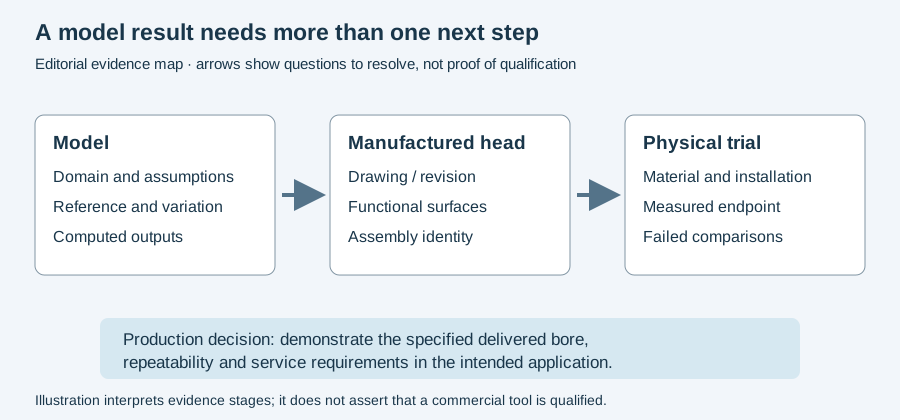
The model-to-trial diagram keeps the proposal and inspected outcome distinct. Use the technical-review proposal to invite a specialist to examine the claimed property effect and the available application evidence. Continue to surface integrity for property-specific evaluation or the contact comparison for other constructions. No life multiplier or operating prescription is assigned here.
Revision note
October 8, 2026: revised the technical explanation and connected reading after source review. Original publication date and URL retained.