A visibly smoother bore surface is an observation of that surface. “Surface integrity” can involve additional material-property questions. Specify the result being claimed before deciding which examination could verify it.
Mechanism does not supply every property result
ECOROLL’s cylinder article explains plastic working of the surface during rolling. Its hydrostatic deep-rolling article discusses changes near the surface and the rolling system that produces them.
These explanations support the distinction between a surface-forming process and material removal. They do not provide the reader’s component with a measured hardness, residual-stress profile or fatigue result.
Match the claim to an examination
| Proposed claim | Evidence the application review needs |
|---|---|
| Texture change | Named parameter, sampled region and evaluation settings |
| Hardness change | Identified examination, location and component state |
| Residual-stress change | Measurement method, depth/location and result |
| Performance change | Defined loading or service endpoint and comparison basis |
This is an editorial evidence map, not a universal qualification plan. The actual requirement determines the examination and applicable controlled procedure.
Retain the incoming state
A surface produced by one preparation route may differ from one produced by another. Record the material condition and preceding machining with the rolling result. If the input, tool and settings all differ, the comparison concerns the combined route rather than an isolated rolling effect.
As an assumed example, two samples both report an improved texture parameter after treatment, but only one has a measured residual-stress profile. Their available evidence differs; the second sample’s property result cannot be assigned to the first.
Separate geometry and performance
The ECOROLL cylinder account also describes its floating skiving construction as following the incoming bore. Texture improvement cannot therefore close a missing axis-related requirement. Nor does a material-property result alone establish service life for every loading condition.
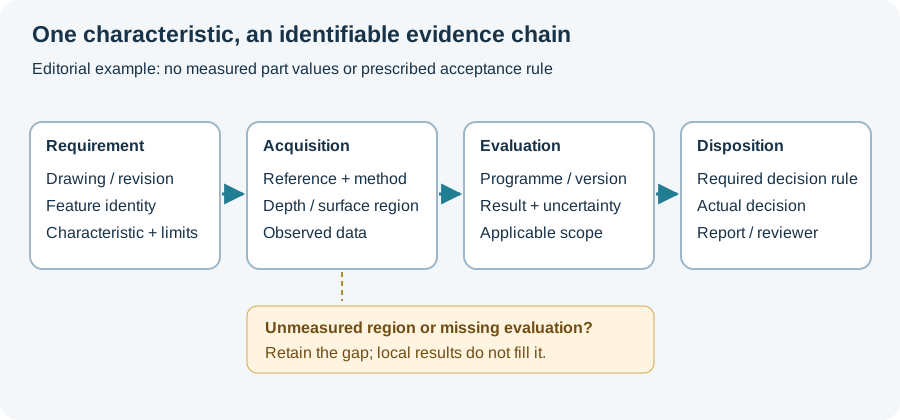
The report-chain diagram keeps each evaluated characteristic attached to its identity and scope. Use the technical-review proposal to define an expert assessment of the supplied claim and its missing evidence. Continue to hydrostatic rolling for a specific construction or measurement methods for surface-result coverage. No universal stress distribution or fatigue multiplier is inferred from the process name.
Revision note
October 8, 2026: revised the technical explanation and connected reading after source review. Original publication date and URL retained.