The term “single pass” is ambiguous if it does not say which operation occurs during each direction of travel. A combined head can perform cutting and rolling together or reserve rolling for the return. Those routes have different timing and parameter relationships.
A supplier’s two stated cycles
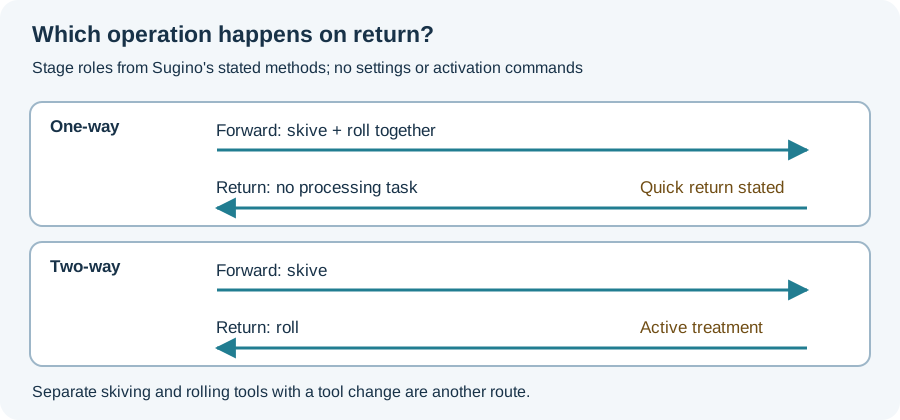
Sugino describes a one-way method that skives and burnishes on the forward stroke, followed by quick return. Its two-way method skives forward and burnishes on return. The latter separates the operating conditions for the two tasks, while the former performs both within one forward treatment.
The cycle diagram below represents those stated roles. It omits activation commands, travel clearances and operating values, which belong to the selected tool’s instructions. It should not be used as a controller programme.
A separate-tool route is another arrangement
ECOROLL’s cylinder-processing page describes separate skiving and rolling tools, including a lathe concept with an automatic tool change. That is a different arrangement from one combined head making an active rolling return.
Record the actual sequence rather than comparing all routes under a generic “two-pass” label. A tool-change interval, a second processing stroke and an active return consume time in different ways and require different hardware.
Compare the whole interval
For an assumed cycle study, identify the start and end points: part loaded and located, required operations completed, and output ready for the specified inspection or delivery step. A shorter forward stroke is not necessarily a shorter complete interval when setup, return or inspection differs.
Keep the material condition, incoming bore and final requirements common to the comparison. If the route also changes preparation or inspection coverage, identify that difference before attributing an accepted-output change to the cycle alone.
Setting freedom is useful only within a verified application
Separately selecting cutting and rolling conditions is an architectural option. It does not itself prove better texture, lower cost or more accepted components. Retain the actual settings and inspected outcomes for the selected configuration.
Use the RFQ worksheet to request the named architecture and included sequence. Continue to parameter interpretation to separate selection from arithmetic, or the CNC-lathe article for the separate-tool layout. The public descriptions establish available routes, not a universal winner.
Revision note
October 8, 2026: revised the technical explanation and connected reading after source review. Original publication date and URL retained.