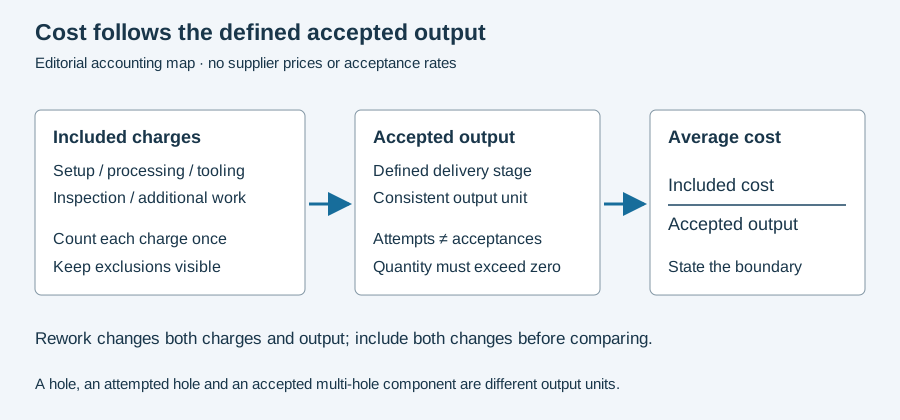
A shorter machining stroke is one cost input. Skiving and burnishing cost also depends on the preparation supplied, complete cycle, service interval and inspection included in the delivery scope.
Preserve the architecture behind the time
Sugino’s cycle description distinguishes quick return after one-way treatment from active rolling on the two-way return. ECOROLL also describes separate-tool routes with a tool change. Their isolated stroke times cover different tasks.
For a time comparison, identify loading, locating, preparation, processing, return, tool changes and the chosen delivery boundary. Keep inspection and handling explicit when they differ between offers. Do not apply a supplier’s general cycle advantage to an unspecified tube as observed cost savings.
Use the same output unit
Define whether the comparison concerns accepted finished bores or accepted components. For a multi-bore part, those may differ. The calculator below uses accepted holes; use it for a finished-bore count only when that is the actual independently accepted output unit.
As a deliberately assumed single-bore comparison, route A incurs 1,200 cost units for 100 accepted bores: 12 per accepted bore. Route B incurs 1,080 for 80 accepted bores: 13.50. Lower included charges do not produce a lower average in this example. The inputs are invented, not market prices or predicted acceptance rates.
Avoid hidden duplicate charges
State which tooling, fluid, inspection and setup charges are already included in a machine rate before adding separate lines. Keep nonconforming and reworked output within the same defined accounting boundary. If preparation is outsourced, compare its included scope rather than treating it as a free incoming condition.
Keep estimate and observed result separate
An estimated acceptance count remains an assumption until actual inspection supplies it. A quotation and a measured batch cost are different records. Retain the input state and complete route beside either one.
The cost diagram separates included charges and accepted output. Continue to the cycle comparison for processing roles or bore preparation for the incoming scope. The calculator performs division; it does not predict tool life, rework yield or the economic winner.
Revision note
October 8, 2026: revised the technical explanation and connected reading after source review. Original publication date and URL retained.