Skiving and rolling parameters belong to a selected tool cycle. Before reading a speed or feed value, identify whether it applies to cutting, rolling, both together or return travel with no processing task.
The cycle determines setting relationships
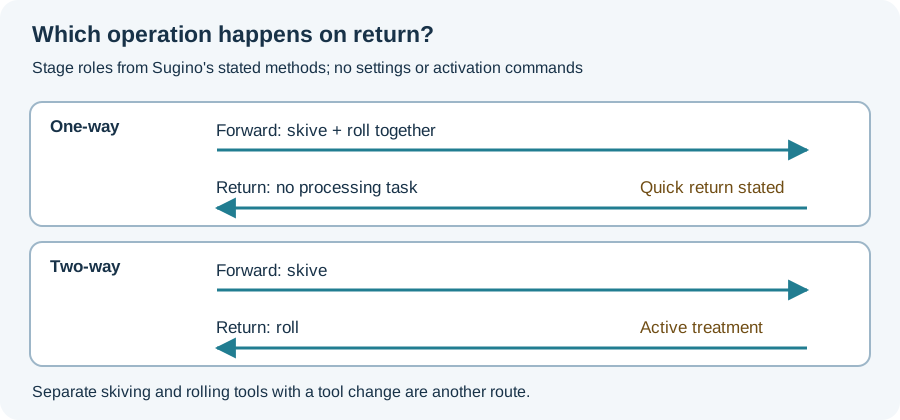
Sugino’s two stated methods make the distinction concrete. One-way treatment performs cutting and rolling on the forward stroke. Two-way treatment cuts forward and rolls on return, allowing separate conditions for those tasks. A rapid-return quantity from the former is not the rolling setting of the latter.
The diagram below retains those roles without operating values. It explains the relationship; it does not replace the selected tool’s operating instructions.
A dimensional command needs units and context
Keep peripheral speed, rpm, feed per revolution and feed per minute distinct. The conversion is arithmetic; it does not establish a suitable input for the material, incoming bore or tool configuration.
For a deliberately assumed example, D = 80 mm and vc = 160 m/min give n = 1000vc/(πD) ≈ 636.62 rpm. An assumed feed of 0.5 mm/rev then gives approximately 318.31 mm/min. These are invented teaching inputs, not a cutting or rolling recommendation. The converter below reproduces the unit calculation.
Tool actuation is another quantity
The OMEGA control table distinguishes RETRAC and international actuation arrangements with different pressure-state sequences. Do not confuse that hydraulic control pressure with a cutting quantity or assume the same sequence for another assembly. Identify which circuit and connection the quoted value concerns.
Read the trial against the stage it tests
Retain the input state and the actual stage commands with the inspected output. If both cutting and rolling conditions change, report the combined change. A final texture result cannot isolate which changed quantity contributed without the relevant comparison.
Continue to stock allowance for the incoming condition or setup for the control interfaces. No universal speed, feed or hydraulic pressure is selected from these public architecture descriptions.
Revision note
October 8, 2026: revised the technical explanation and connected reading after source review. Original publication date and URL retained.