Compare the same finished-bore requirement
Define the incoming blank, material condition, available stock, bore ends and drawing requirements before asking for a preferred finishing method. A vendor’s cycle-time claim is tied to its own configuration; this comparison does not establish a universal winner.
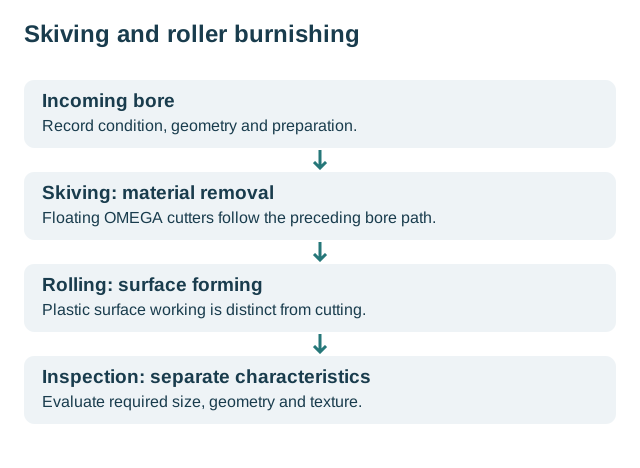
ECOROLL’s English explanation and German counterpart, dated October 17, 2024, describe a combined cutting and roller-burnishing arrangement. They explain that rollers plastically work the surface after cutting. This is manufacturer process context, not an independent comparison of every honing and SRB installation.
Request a matched trial proposal
| Comparison input | Ask both providers to document |
|---|---|
| Incoming bore | Material condition, dimensions, form and allowance |
| Finished requirement | Size, form, functional texture and drawing reference |
| End geometry | Access, interruptions and the length actually processed |
| Measurement | Locations, parameter, evaluation conditions and uncertainty |
| Production route | Preparation, processing, handling, inspection and rejected parts |
| Tool service | Consumables, replacement/reconditioning and quoted exclusions |
Evaluate the result as a process chain
Ask for results on comparable incoming parts and retain the actual inspection reports. A roughness number alone cannot decide whether all functional requirements have been met. Record any different preparation or inspection conditions beside the result. Keep a proposed economic advantage attributed to its supplier until matched evidence supports the comparison.
Use the quality worksheet to define acceptance and the RFQ worksheet to compare scope. No default stock allowance, roughness target or cycle-time multiplier is supplied here.
Sources and their limits
ECOROLL cylinder processing (German): Named combined and separate finishing arrangements; vendor economic claims are not universal conclusions.
PTB surface metrology (German): Metrology context; not proof of instrument access or component acceptance.
Compare the actual guidance and surface architectures
Sunnen’s process description describes abrasive honing with rotation and reciprocating strokes. Gehring’s original explanation links that motion to intersecting surface traces and explains an articulated, self-centering arrangement that adapts to bore position and inclination. It also explicitly identifies rigid position-honing as an exception.
Read that scope beside ECOROLL’s floating skiving example. Neither source establishes a blanket rule that every honing or SRB arrangement corrects the same geometry. The exact head, mounting and evaluated characteristic matter.
Functional texture should remain a drawing question. A lower scalar roughness value does not describe every difference in surface structure or prove suitability for a specified seal contact. Keep the required parameter and evaluation beside the route comparison; the stages diagram illustrates cutting and forming, not a universal substitution for the honing requirement.
Revision note
October 8, 2026: revised the technical explanation and connected reading after source review. Original publication date and URL retained.