A BTA vibration damper supports the tool tube and acts on its dynamic behaviour. A claim that the bore path has been corrected needs geometric measurement as well. These results can be related in an investigation without being treated as the same measured characteristic.
A published construction comparison
UNISIG’s July 2023 article describes standard assemblies set through tensioning locknuts and tapered collets, and hydraulic assemblies whose clamping condition can be adjusted during drilling. It describes manual or central hydraulic supply, with settings potentially included in a configured CNC program. The German counterpart gives the same architectural distinction.
These are manufacturer descriptions. They identify what an offered assembly does and how it can be adjusted; they do not provide a universal support spacing, damping factor or proved centerline-correction result.
Identify the dynamic observation
Retain the tube/head assembly, support positions and adjustment state alongside the signal acquisition arrangement. Mark drilling depth and the onset of the observed event. An adjustment made during the bore needs its time recorded so the later trace can be compared with the actual configuration.
Schmidt’s 2024 dissertation, printed page 109 and the summary, shows why channel identity matters: the strongest frequency can differ between torque, axial-force and sound-pressure records. A single reduced audio peak is therefore an incomplete description of an intervention.
Measure the delivered geometry separately
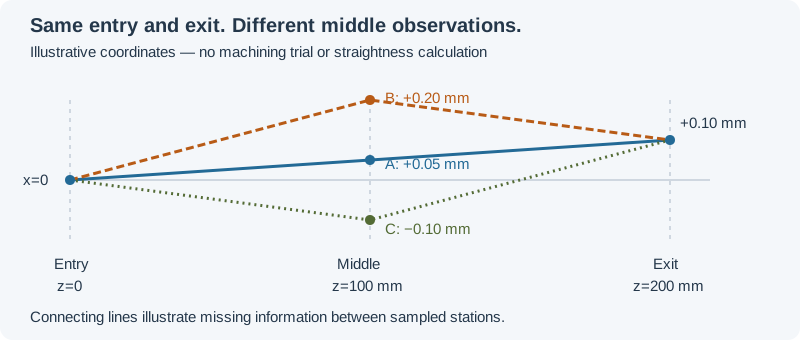
Use the bore’s identified inspection result for a path or position claim. The bore-path diagram below illustrates why matching entry and exit positions does not describe every possible intermediate path. A quieter process is a dynamic observation; whether the required path changed is another question.
If the head, tube and support arrangement all changed in a trial, report that complete configuration change. Do not assign the result to the damper alone without evidence that separates those effects.
The incident worksheet retains the adjustment event and dynamic record alongside the geometric outcome. Continue to vibration assessment for channel comparison, or geometry diagnosis to define the characteristic and measurement coverage that actually failed.
Revision note
October 8, 2026: revised the technical explanation and connected reading after source review. Original publication date and URL retained.