BTA white-layer formation cannot be assigned to guide pads alone from the presence of a hard surface layer. The published research distinguishes material removal, subsequent pad contact and the methods used to characterize the resulting subsurface. The mechanism and the measured feature need to remain separate questions.
What the investigated setup establishes
The 2024 Production Engineering study examines quenched-and-tempered AISI 4140 with a 60 mm BTA head. It combines process observations with metallographic, magnetic and diffraction investigations. The 2025 correction replaces Figure 19; comparisons of that figure’s material-characterization results need the corrected version.
The article reports that white-etching layers can also occur in BTA analogy experiments involving cutting without guide-pad contact. Its discussion of chatter identifies dynamic disturbances as a reinforcing factor in the investigated material. Neither finding supports a universal pad-only cause or one speed/feed boundary for every BTA setup.
Separate cutting from subsequent forming
Robert Schmidt’s 2024 TU Dortmund dissertation, particularly the summary on printed pages 145–148, describes analogy tests used to isolate the outer cutting-edge effect from pad-related surface conditioning. The separation matters when interpreting a layer observed after the complete process: the finished specimen contains effects of both stages.
This also explains why a change in pad condition is a hypothesis to investigate rather than automatic proof of origin. Retain tool, material, process and specimen identities together.
Different methods answer different questions
The Production Engineering paper describes prepared cross-sections for optical assessment, complementary microstructural analysis and magnetic/X-ray methods. It notes nonuniform layer thickness and the difficulty of treating one micrograph as representative of the whole specimen. A local image and a measurement covering another region may therefore refer to different sampling scopes.
The article also discusses limitations in transferring magnetic correlations to changed conditions. A magnetic signal change is not a universally calibrated layer-thickness reading. Record the method, location, preparation and evaluated property before treating the result as confirmed layer evidence.
A proposed controller is a different evidence stage
The dissertation’s outlook describes an integrated magnetic sensor intended for future attempts at detecting layer formation and developing control. That stated development direction is not a demonstrated production remedy for the reader’s component.
Define the applicable component requirement before proposing removal or parameter changes. A smoother surface alone does not resolve a subsurface question, and this review supplies no universal removal allowance or rejection thickness.
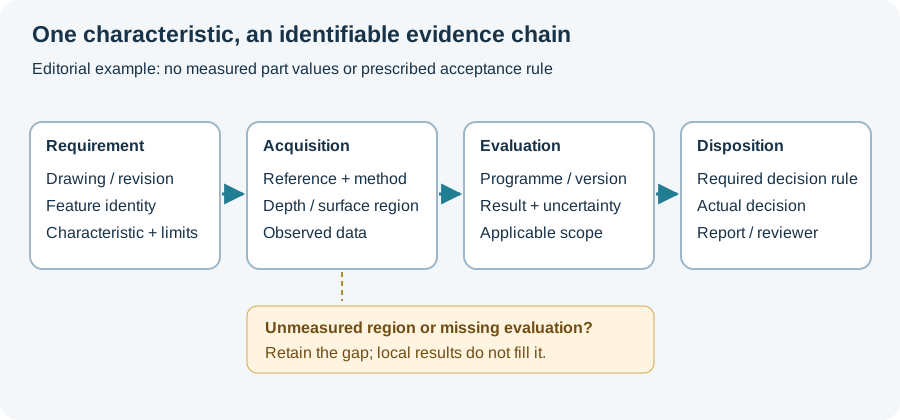
The measurement-evidence diagram below separates acquisition from disposition. Use the quality worksheet to define the required evaluation, then continue to the surface-integrity or vibration articles for the remaining process question.
Revision note
October 8, 2026: revised the technical explanation and connected reading after source review. Original publication date and URL retained.