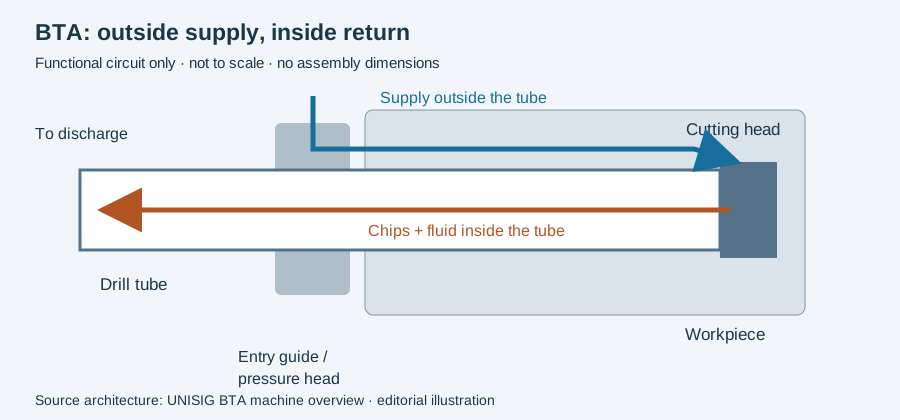
Deep hole drilling chip evacuation cannot be investigated from a method-free description of “blocked chips.” First identify where fluid is supplied and where chips return for the installed tool arrangement. Then describe the change that was actually observed.
The drilling method changes the path
UNISIG’s process explanation distinguishes these two arrangements:
| Method | Fluid supply described by the source | Chip exhaust described by the source |
|---|---|---|
| Gun drilling | Inside the tool | External groove along the tool |
| BTA drilling | Externally around the tool | Through the drill/tool’s internal exhaust path |
Name the actual machine and tooling configuration alongside this general distinction. It explains why a generic “return-path check” can point to the wrong part of the installation if the method is omitted.
Record the change in returning chips
Keep observation location, time and corresponding drilling depth. Separate “no returning chips observed at this point during this interval” from “the path was blocked.” The first is a record; the second is an explanation that needs support.
Compare available fluid readings and machine events on the same timeline. A pressure snapshot from a later idle state cannot document what happened while the chip return changed. Retain samples or photographs through the site’s established collection procedure and associate them with the correct run.
Three questions for one illustrative event
Assume an invented record says returning chips become intermittent later in a bore. The investigation could consider a delivery change, a return-path restriction or a tool/chip-formation change. These are alternative questions, not a declaration that all three occurred.
| Question | Evidence that would help examine it | What remains open |
|---|---|---|
| Did fluid delivery change? | Comparable readings at identified points during the event | A pump display alone may leave downstream delivery unresolved |
| Was the actual exhaust route restricted? | Authorized inspection of the identified route and retained finding | The symptom alone does not locate a restriction |
| Did tool or cutting conditions change? | Tool identity/condition, settings and associated chip observations | A chip sample does not establish the whole cause |
An absence of a recorded change can also reflect missing measurement coverage. Keep an unmeasured condition separate from a measured stable one.
Test the explanation, then inspect the bore
An approved intervention should state what it tests. Retain the before/after conditions and the observation that would support or leave the explanation unresolved. If several conditions change, report the combined recovery without assigning the outcome to one unisolated cause.
Do not close the incident solely because chips return again. Keep the bore inspection and tool condition with the recovery record. The coolant-system investigation examines the upstream circuit; gun-drilling problems routes other observed defects to their own evidence.
The incident worksheet is designed for this record. It preserves observation and explanation separately so a later reviewer can see what was established and which questions remain open.
Tool wear is another hypothesis with a defined research example
Tamura and Matsumura’s full 2024 paper provides a physical and modeled wear/chip-flow sequence for a 6 mm, two-flute TiCN-coated HSS drill making 40 mm blind holes in 0.5% carbon steel. Its Table 1 specifies dry conditions. This matters before borrowing the result for internally cooled gun drilling or BTA.
The authors relate changes around the worn lip ends and margins to a more radial chip flow and greater interference with evacuation. Their measured thrust/torque analysis distinguishes wear-related and clogging-related contributions. It shows why a changing load can deserve more than one hypothesis, while supplying no universal force threshold for another method.
An actual investigation should connect the chip-return observation with edge condition and fluid evidence from the same event. Gühring’s stationary actual-tool pressure/flow check can contribute a configured supply observation, but does not independently prove the cutting-zone state during the fault. The timeline below keeps those different evidence scopes visible.
Revision note
October 8, 2026: revised the technical explanation and connected reading after source review. Original publication date and URL retained.