Deep hole drilling coolant troubleshooting needs the installed circuit and the operating state attached to every reading. A number displayed beside a pump does not locate a problem throughout the supply and return system.
A named example of the circuit
KNOLL’s LubiCool-M description separates dirty-fluid transfer to a compact filter, collection in a clean-medium tank and delivery by a high-pressure pump through switchable outlets. This is one published installation concept, not a universal diagram for every deep-hole machine.
For the actual installation, mark those functions on the provider’s schematic where they exist, then identify connections, valves, consumers and available sensors. Use the installed documentation to locate a reading. Keep the distinction between a pump setting and a measured condition at another point.
Compare like operating states
An illustrative log below uses invented values and does not specify a required pressure:
| Record | Point | State | Reading |
|---|---|---|---|
| A | Pump-side sensor P1 | Idle circulation | 80 bar |
| B | Tool-side sensor P2 | Cutting | 65 bar |
| C | Pump-side sensor P1 | Cutting, same interval as B | Not recorded |
Subtracting B from A gives 15 bar arithmetically, but it does not establish a simultaneous pressure drop between P1 and P2. Both the point and the operating state changed. The useful missing comparison is a contemporaneous P1 reading under B’s conditions, obtained through an approved measurement procedure.
No result in this example establishes whether either pressure is adequate for the actual drill. That question needs the applicable tool and machine requirements, including delivery conditions beyond a single pressure value.
Follow the unresolved function
If the evidence concerns collection or transfer, investigate that documented function. If it concerns high-pressure delivery, identify the pump/outlet configuration and the relevant measurements. Do not skip the clean tank and filter solely because the event appeared at the tool.
| Function | Record to retain | Conclusion to avoid without it |
|---|---|---|
| Transfer/collection | Circuit identity and observed state | Locating a supply defect from a downstream symptom alone |
| Filtration | Filter/media identity, maintenance and authorized findings | Declaring a filter blocked from one pressure reading |
| Clean supply and outlets | Actual configuration and time-aligned operating records | Assuming all consumers saw the same delivery |
| Measurement | Location, units, instrument and state | Comparing values as if they came from one paired test |
This is an editorial tracing aid. Electrical, hydraulic and maintenance work follows the provider’s and site’s approved procedures.
Distinguish recovery from cause and acceptance
Keep the proposed explanation separate from the finding. “P2 changed during cutting” and “the filter caused the change” belong in different fields. A restored reading after several interventions documents recovery; it does not isolate which intervention caused it.
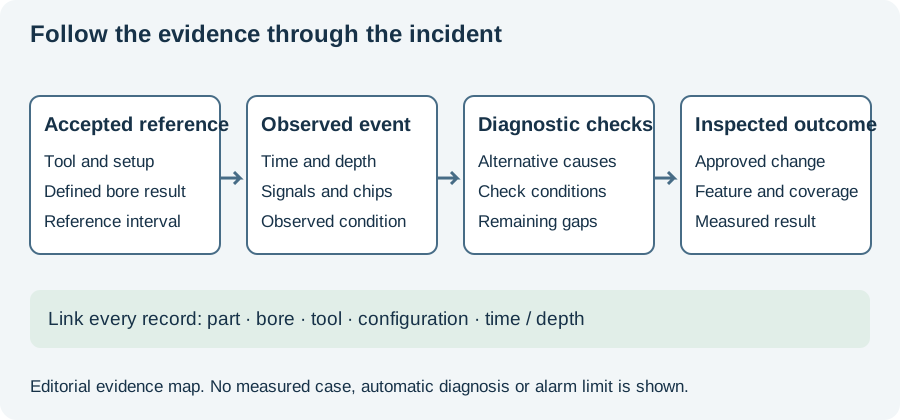
Retain the authorized change, trial state, measured delivery and the bore-quality outcome. Continue to chip evacuation if chip return remains the unresolved observation, or filter selection when the task is specifying a replacement. Use the incident record to keep the completed checks and unresolved functions together.
Check the actual-tool delivery without changing its meaning
Gühring’s PQ3000 description supplies a second, distinct measurement concept: pressure and flow are checked with the actually installed tool in a stationary spindle. That brings the tool/holder configuration into the supply observation. It is still not a measurement of every condition during cutting.
Retain the measurement state and circuit point beside the result. If a later fault occurs during penetration, the stationary check provides evidence about its own test arrangement; the missing in-cut observation remains missing. The same distinction applies when comparing a pump display with a reading at the tool.
The German KNOLL description confirms the published dirty-transfer, filtration, clean-tank and switchable-outlet roles used in the circuit explanation above. Map the corresponding roles on the installed schematic where they exist. Neither source establishes that a blocked filter, weak pump or restricted tool caused an incident solely from its downstream symptom.
Revision note
October 8, 2026: revised the technical explanation and connected reading after source review. Original publication date and URL retained.