Deep hole drilling process optimization should state what is improving and what remains inside the comparison. A lower fluid-flow requirement, shorter cutting interval and lower cost per accepted bore are different measures. A successful result in one does not supply the others.
A research result has a defined boundary
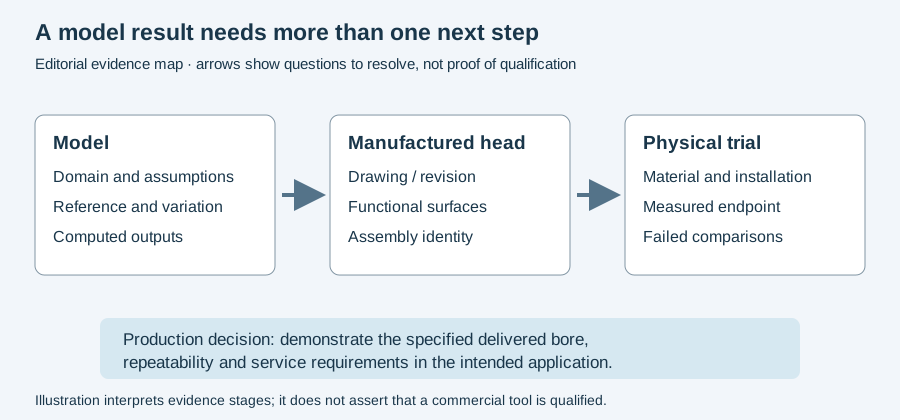
Rupasinghe and colleagues’ ejector study compares defined head designs through simulation and physical trials. The work investigates chip evacuation and the fluid supply needed for stable drilling in its experimental configurations. Its hydraulic comparison is not a measurement of total machine energy, sustained factory output or the reader’s finished-route cost.
The model-to-trial diagram below separates predicted behaviour, the manufactured design and an application trial. Keep those evidence stages identifiable when selecting a production proposal.
Store the accepted baseline
Record the tool, setup, program, material condition and inspection scope associated with the baseline. Retain what counts as accepted output at the delivered stage. If a route adds honing or another finishing operation, include that operation in both sides of a complete-route comparison rather than counting the earlier drilled hole as delivered.
For fluid-related changes, record comparable pressure/flow observations. Gühring’s actual-tool check illustrates a stationary delivery measurement; it should remain labelled as that test rather than becoming an unrecorded in-cut result.
A faster cut can leave fewer accepted bores
Consider an invented accounting example: a baseline costs 1,000 units for 100 accepted bores, while a changed route costs 960 units for 80 accepted bores. The corresponding costs are 10 and 12 units per accepted bore. The assumed example explains why total spend alone can hide a changed denominator; it reports no machining trial.
Retain held and rejected output, inspection, tool service and downtime within the declared boundary. Keep several simultaneous changes visible as a configuration change rather than crediting one parameter without separation.
Review what persists in production
A trial result identifies a configuration worth evaluating. Comparable production intervals show whether the intended output is sustained. Keep setup and service changes identifiable before pooling results.
Use the accepted-output calculator for the declared cost boundary. Continue to optimization methods for trial design, or coolant/tool-life comparison when the proposed gain concerns service intervals.
Revision note
October 8, 2026: revised the technical explanation and connected reading after source review. Original publication date and URL retained.