A measured example rather than a universal cure
A 2024 BTA study compares microphone and mechanical-signal spectrograms to investigate chatter. The paper concerns a defined AISI 4140 experiment, and has a 2025 figure correction. Study · Correction.
UNISIG separately describes supports for long BTA tools as part of its machine architecture. Manufacturer machine overview. Neither source establishes a universal speed change or support spacing for every installation.
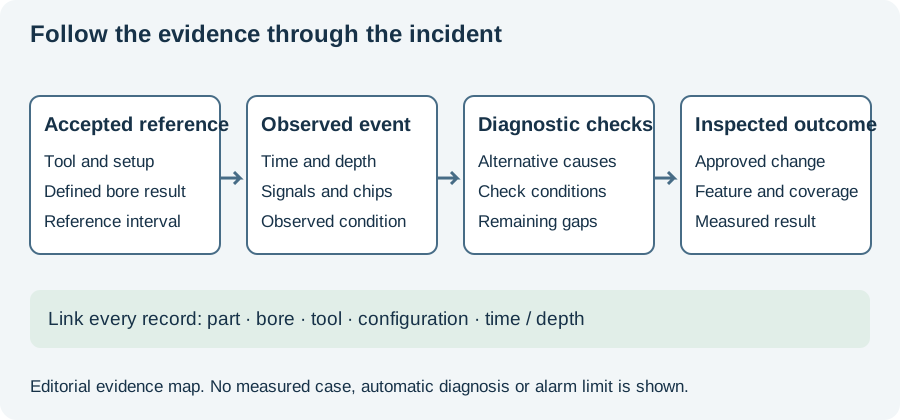
Preserve the event in time and depth
Our suggested incident record starts with the time of onset and drilling depth. Add the named tool assembly, rotation mode, support configuration, operating commands and available load or acoustic recordings. Keep a record of the corresponding bore inspection.
| Observation | What to compare |
|---|---|
| Event begins at a repeated depth | Same assembly and support state at that depth |
| Acoustic signal changes | Time-aligned load signals and operating state |
| Tool intervention changes the event | Before-and-after assembly inspection |
| Bore surface changes | Measured location linked to the event record |
| Alarm occurs during the event | Alarm timestamp and machine operating history |
These are investigation prompts, not cause assignments. Multiple simultaneous changes make the result harder to interpret.
A corrective trial needs two outcomes
Document whether the observed event changes and whether the delivered bore meets the agreed requirements. A lower recorded sound level alone does not demonstrate a qualified machining result. Likewise, one accepted bore does not establish long-term stability across the operating envelope.
Keep the baseline, the single proposed change where practical, and the inspection plan together. Follow the actual machine and tool procedures when implementing the trial; this page supplies no numerical vibration remedy.
Use the incident worksheet to organise the record. If subsurface changes are suspected, read the white-layer evidence review before treating roughness as the complete acceptance evidence.
The strongest peak need not be the same in every channel
The paper’s matched microphone/strain-gauge example should not become a universal rule that the largest audio peak always equals the largest mechanical peak. In his 2024 German dissertation, Schmidt compares torque, axial-force and sound-pressure spectrograms and explains that their dominant frequencies can differ. Printed page 109 identifies different strongest components in a defined example; the summary on page 146 retains that qualification.
For an application record, preserve the individual channels and their acquisition conditions. Compare the time interval and spectral components rather than replacing several measurements with one headline frequency. The published examples do not establish an alarm threshold for another tube or support arrangement.
A damper setting is part of the changing configuration
UNISIG’s dampener description distinguishes manually set tapered-collet assemblies from hydraulically adjusted constructions. If the installed system changes its clamping condition during a bore, record the setting and event time with the vibration observation. An intervention can then be compared with the corresponding drilling region and inspected surface.
The neighboring BTA article explains that adjustment architecture; this page evaluates the observed event. Keep the dynamic result and delivered bore result separate when deciding whether the trial resolved the original problem.
Revision note
October 8, 2026: revised the technical explanation and connected reading after source review. Original publication date and URL retained.