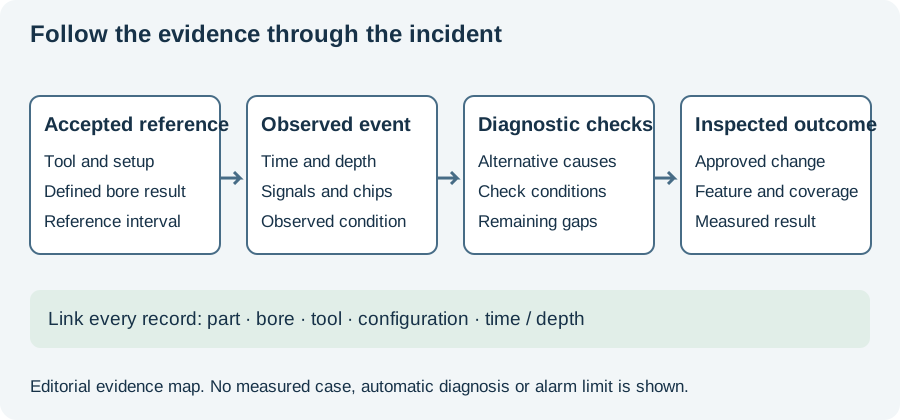
To diagnose deep hole drilling problems, construct the event sequence before assigning a cause. The last accepted bore, first deviation and intervening changes anchor the investigation. Missing records should remain unknown rather than being filled with an assumed normal state.
An illustrative incident remains unresolved
Assume an invented record reports a load change and intermittent chip return late in a bore. The removed drill shows an altered edge, while the only fluid check was taken later with the spindle stationary. These are hypothetical observations for a diagnostic exercise, not a published failure case.
One explanation concerns changed delivery; another concerns changed chip formation or interference with evacuation. Neither is confirmed by the observations as written. Record the material lot, tool/service history, setup and program before selecting a check.
Compare what each record can establish
Gühring’s actual-tool pressure/flow check is explicitly a stationary-spindle measurement. Applied to the assumed incident, a later check can describe that arrangement but cannot reconstruct the missing in-cut delivery history.
Tamura and Matsumura’s experiment links edge evolution, chip form and force observations for dry drilling with a 6 mm twist drill. It provides a reason to examine those relationships in a wear hypothesis, not proof that they caused this invented event or a wet gun-drilling fault.
Ask a discriminating question
An editorial investigation should identify which evidence would strengthen or weaken each explanation. Obtain the relevant circuit finding through the approved procedure, and associate edge/chip observations with the actual drilling interval. Retain contrary findings as well as supporting ones.
If the available evidence cannot distinguish the explanations, report that limitation. A later recovered cycle can be useful information without proving the original cause. Likewise, an edge photograph after removal does not date the onset of its condition.
Close against the original requirement
Record the justified change, approved trial configuration and inspected result. Separate whether the observed event changed from whether the delivered bore met the specified characteristics. Leave unresolved mechanism questions visible.
The timeline below and incident worksheet keep observation, hypothesis, check and outcome together. Continue to coolant tracing or wear analysis according to the evidence gap that remains.
Revision note
October 8, 2026: revised the technical explanation and connected reading after source review. Original publication date and URL retained.