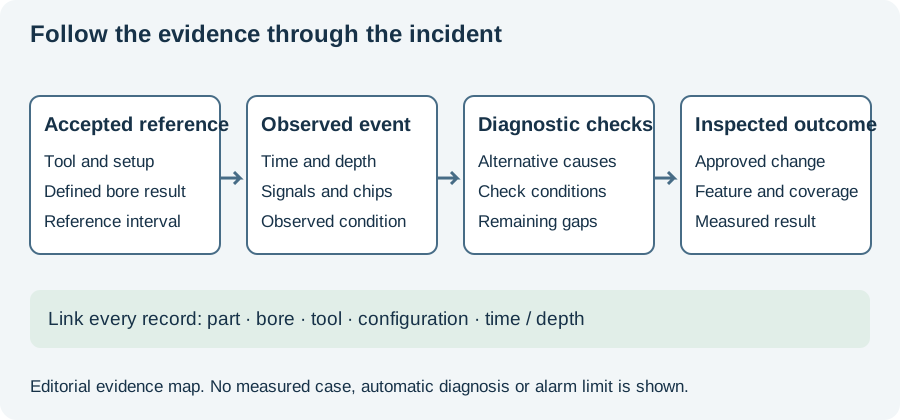
Choose the next deep hole drilling investigation from the observation actually recorded. A symptom table should help locate the missing evidence. It should not turn each symptom into a unique cause or an automatic parameter change.
Match the observation to its technical question
| Observation | Retain first | Next investigation |
|---|---|---|
| Coolant display or delivery changed | Point, state, unit, circuit and time | Circuit tracing |
| Chip return became intermittent | Method, outlet, depth and sample interval | Supply and return paths |
| Chip form or edge condition changed | Matched sample, tool and service interval | Wear sequence |
| New sound or vibration appeared | Channel, time/depth and assembly state | Vibration assessment |
| Bore size/path/position failed | Feature, reference, coverage and part state | Geometry diagnosis |
| Machine motion differed from the plan | Intended operation and exact executed file | Programming handover |
The table is an editorial navigation aid. More than one row can apply to the same event.
Do not broaden a named example
Star Cutter’s gun-drilling account discusses several possible contributors to poor results. Its process and source identity should remain attached to that advice. A BTA or ejector incident needs the corresponding tool and fluid paths rather than a method-free remedy.
KNOLL’s LubiCool-M description distinguishes dirty transfer, filtration, clean supply and switchable high-pressure outputs. It helps illustrate why a downstream observation need not identify which upstream function changed. Use the actual installed schematic for that investigation.
Keep the acceptance question visible
A changed signal, an altered tool and an inspected defect are different findings. If the symptom concerns a bore characteristic, retain the relevant measurement even when an alarm has stopped occurring. Novacam’s profile-based straightness description illustrates that the coverage and evaluation belong to the geometric result.
The incident worksheet stores those relationships; the timeline below shows their order. Continue to the diagnosis walkthrough for competing explanations or the general framework when the incident crosses several technical categories. Recovery and intervention follow the actual machine/tool procedure and the responsible site’s approved action.
Revision note
October 8, 2026: revised the technical explanation and connected reading after source review. Original publication date and URL retained.